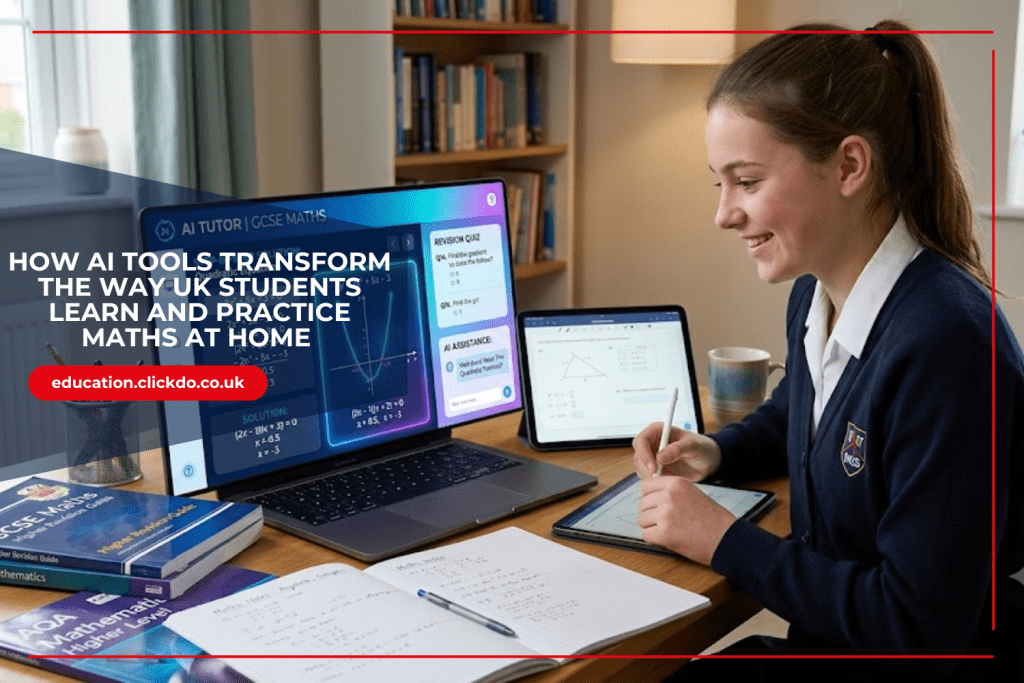
Maths homework has always caused groans around British kitchen tables. That’s changing. A quiet shift is under way, with artificial intelligence in home learning now a normal part of revision.
Recent research found that eight in ten UK teenagers already use AI tools for schoolwork, and maths ranks among the most common subjects for that help.
For many families, this is the first real answer to years of stuck equations and tears over fractions at bedtime.
AI Maths Homework Help Goes Mainstream


Not long ago, asking a chatbot for help with algebra felt experimental. Now it’s routine, with homework help sitting near the top of the list of reasons UK teenagers give for using AI.
Parents can’t always explain simultaneous equations at 8 p.m. on a Tuesday. Many never learned quadratic formulas the way schools teach them today anyway. Fortunately, with AI, you can scan and solve math problems much more easily and without the help of parents. Moreover, the Math AI Extension not only solves the problem but also provides step-by-step guidance so students can repeat and learn to solve similar formulas on their own.
Where GCSE Maths Still Bites
Despite all this help, results tell a mixed story. In 2025, only 58.2% of GCSE entries in England achieved a grade 4 or higher in maths, a slight dip from the year before. Thousands of students still resit the exam every November.
Numbers like these explain the appetite for extra support at home. Maths punishes small misunderstandings early and lets them compound. Miss one step in Year 9, and Year 11 can start to feel impossible.
Digital Maths Tutors, Minus the Awkwardness

This is where digital maths and GCSE tutors for students come in. Unlike a human tutor, an AI tutor never sighs, never checks the clock, and never makes a student feel silly for asking the same question twice.
It’s available at 11pm before a mock exam, or during a rainy Sunday revision session. Some children simply learn better without an audience watching them get something wrong.
Breaking Down Complex GCSE Equations
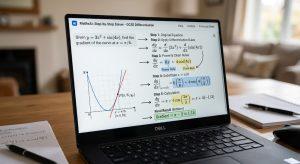
A good AI tool doesn’t just spit out an answer. It can break down complex GCSE equations into small, manageable moves, showing which rule applies and why, rather than presenting a final number that seems to arrive from nowhere.
That distinction matters more than it sounds. Students who see the “why” behind each step tend to apply the method again later, in a slightly different question, without needing to be shown twice.
Explanations Built Step by Step
Ask the same tool to generate step-by-step maths explanations, and it will usually walk through the working exactly as a teacher would at the whiteboard, minus forty other students competing for attention.
This slows things down, in a good way. Rushing was often the real problem in the first place.
Personalised Revision Quizzes for Real Weak Spots
Generic revision packs treat every student the same. AI tools don’t have to. By tracking which topics trip a student up, they can create personalised revision quizzes that spend more time on ratio and less on topics already mastered.
This matters for GCSE maths specifically, where the syllabus covers dozens of distinct skills and nobody has time to redo everything from scratch three weeks before an exam.
Catching the Small Slips
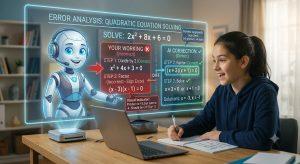
Sometimes the concept is fine but the arithmetic lets a student down. A good AI tutor can spot arithmetic calculation errors mid-working, flagging exactly where a sign was dropped or a decimal moved the wrong way.
That’s a small thing with a big effect on confidence. Losing marks to a silly slip, rather than a genuine gap in understanding, is one of the most demoralising parts of school maths.
Building the Habit of Active Recall
Rereading notes feels productive. It rarely works as well as testing yourself. AI-generated quizzes make it easy to master active recall formulas and methods, the approach most cognitive scientists point to as genuinely effective for retention.
Short, regular tests beat one long cram session. Students who use these tools daily, even for ten minutes, tend to retain formulas longer than those who only revisit them the night before an exam.
Untangling Abstract Calculus

Calculus trips up even strong students, mostly because it asks them to reason about change rather than fixed numbers. A tutor that can explain abstract calculus principles using a real-world example, gradients on a hill, speed changing over time, often succeeds where a textbook definition alone does not.
Visualising the idea first, then attaching the notation to it afterwards, tends to stick.
One Approach, Every Curriculum
England, Wales, Scotland and Northern Ireland don’t teach maths identically, and neither do international schools. The stronger tools support diverse school curriculums, adjusting explanations to GCSE, A Level, Scottish National 5s, or the IB, rather than assuming one national syllabus fits all.
For families juggling different exam boards, that flexibility saves real time.
Removing the Friction From Home Learning
Getting started is often the hardest part of any revision session. AI tools remove maths home learning friction by being instantly available, with no login queue, no waiting for a tutor’s reply, no booking a session three days in advance.
That immediacy won’t replace a great maths teacher. What it does is fill the gaps between lessons, those moments when a question comes up and there’s genuinely nobody else around to ask.
None of this makes maths effortless, and it shouldn’t try to. What it does is shrink the distance between confusion and understanding, one worked step at a time. For UK students working through GCSEs, A Levels, and everything after, that distance is often all that separates a grade 4 from a grade 7.
Author Profile


- Shirley Owen is a blogger and writer who enjoys writing blogs on education, technology and general news. An avid reader, she follows all the latest news & developments to report on them through her articles.
Latest entries