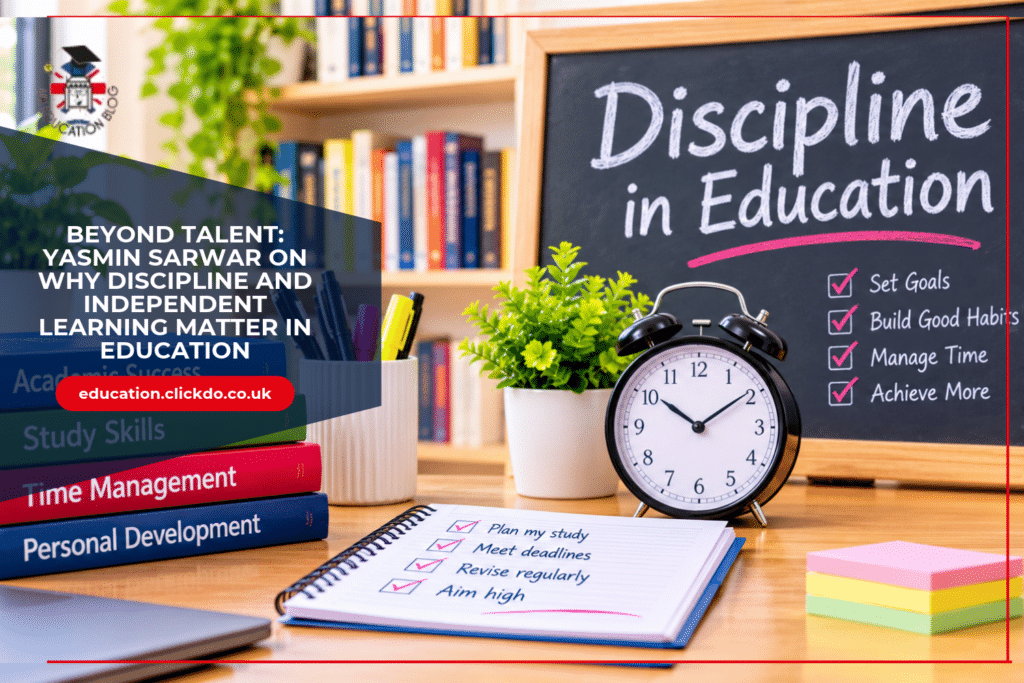
Yasmin Sarwar remembers a student from Albania named Erind, who was studying Maths, Further Maths and Chemistry at Cardiff Sixth Form College.
“He was a very bright and talented young man who had always done well in Maths at his previous school,” she recalls.
After just one week, he came to her feeling completely discouraged. He was surrounded by students who could solve ten questions in an hour, while he was struggling to complete just one. For the first time, he began doubting his abilities and even considered giving up Further Maths.
She told him he had two choices: give up because others seemed better than him, or persevere, develop a strategy and work towards improving. He chose to persevere. A year later, he achieved the best Maths results in the college and was among the top-performing students overall.
“This was a powerful reminder that ability alone doesn’t determine success,” she says. “It’s the resilience to keep going, the willingness to challenge yourself and the belief that you can improve that truly make a difference.”
Sarwar is Founder and Lead Consultant of Quantum Pathways. In 2004 she founded the Cardiff Centre of Excellence, a small private tutorial centre that later became Cardiff Sixth Form College, and she spent years tutoring, coaching and counselling students at close quarters. Talent, she found, helped. It was not enough. The students who improved were those who would return to the work they found difficult, rather than spend their time on what they could already do.
The same habits, she argues, decide how far a student goes in a hard subject, a university application, or any demanding course of study. Music is often held up as a short cut to the same thing. She takes a more grounded view.
The habit that lasts


The folklore around music and intelligence is a useful place to start, because it points in the wrong direction. A much-cited paper published in Nature in 1993 found only a brief lift in adults’ spatial reasoning after they had listened to Mozart, lasting no more than 10 to 15 minutes.
A later review of 54 studies, by Giovanni Sala and Fernand Gobet in 2020, found that music training does not reliably improve children’s wider cognitive skills or their school attainment once stronger comparisons are used.
For Sarwar, that conclusion is not a disappointment so much as a clarification. What music lessons can teach a child is how to practise. That is a different and more lasting thing than a short-lived lift in a test score, and it is much closer to what Erind had to learn at the college, and to what serious study requires.
Progress, in her experience, is slow. It arrives in small steps, stalls for weeks at a time and then, quite suddenly, moves again. A student who learns to keep going through a plateau, whether at the piano or in a hard chapter of chemistry, has had real practice at something that will be asked of them again. An instrument makes that process unusually visible, because the improvement, or the lack of it, can be heard. In academic work the same pattern is easier to hide. A student can look busy for an hour and still have avoided the one question they cannot yet do.
The sticking point is that most students practise badly, for much the same reasons most adults would. Working on the part that already feels fluent is pleasant. Working on the part that keeps going wrong is tedious and exposes every weakness. Those who treated study as a run-through of familiar material often looked busy and fell behind.
Those who could identify the weak point, slow down and stay with it, improved. The same discipline applies to an essay, a problem sheet or a university admissions test. The work that matters is rarely the work that already feels fluent.
Who the learning belongs to
There is a second question, which she regards as just as important as discipline: who the practice belongs to. Many students work because an adult has told them to, and a task is finished because a teacher expects it. In her experience, the habit only becomes durable when a young person starts to set small targets of their own and notices when they hit them. That shift, from doing what is asked to deciding what needs work, is the beginning of independent learning. Sixth form, and then university, both depend on it.
When she first started teaching in the UK, one of the things that struck her was how early students were placed into different ability groups.
“In Malaysia, where I grew up, we also had examinations that influenced our academic pathways, but there was a stronger emphasis on the belief that you could always improve through hard work and perseverance,” she says.
She noticed the difference particularly when students were faced with challenging questions. If you gave a student from the UK and a student from Malaysia a straightforward Maths problem, both would probably attempt it. But when the question became more difficult, she often found that
British students were quicker to say, “I’m not good at Maths,” or “Maths just isn’t for me.” Malaysian students, in her experience, were more likely to keep trying, even if they did not know how to solve it immediately.
“Of course, this wasn’t true of every student, but it was a pattern I observed,” she says.
In Malaysia, students were encouraged to keep working at subjects, even those they found difficult. There was a sense that effort could lead to improvement. In the UK, she felt that the education system sometimes encouraged students to define their abilities too early. With assessments such as the 11+, 13+ and 16+ influencing educational opportunities, some students began to see themselves as either naturally good or bad at particular subjects.
In Malaysia, when she was growing up, students generally followed a broader curriculum until around Year 9, when examinations helped determine whether they would pursue science, commerce or arts. There was more time to develop before making those academic choices.
“The biggest difference wasn’t necessarily academic ability or even independence,” she says. “It was the willingness to keep trying when something became difficult.”
She has always believed that every child has the potential to succeed, but that they need the opportunity to develop resilience and a positive growth mindset, rather than being placed into a box too early.
“Once a student believes they’re simply not good at something, they may stop trying altogether. And that’s when we risk losing not just their confidence, but their potential to improve.”
Teachers can help without becoming supervisors, by asking a young person to show the part that was hardest, rather than the part they like most, and by noticing improvement in specific terms. There will also be weeks when effort slides. That is normal, and rarely a sign that a student has no aptitude. It is often the point at which the habit of patient practice is most worth protecting.
None of this makes music, or any other demanding pursuit, a shortcut to academic success. The value of an instrument still lies in the music itself.
What Yasmin Sarwar would add is that education has a similar hidden curriculum. Talent gets a student started. Discipline, and the willingness to keep going when the work is not yet good enough, are what carry them further. The same choice, made in a classroom or at a desk, is how real learning gets done.
Author Profile


- Passionate education content creator and designer, contributor, writer and content marketing allrounder.
Latest entries