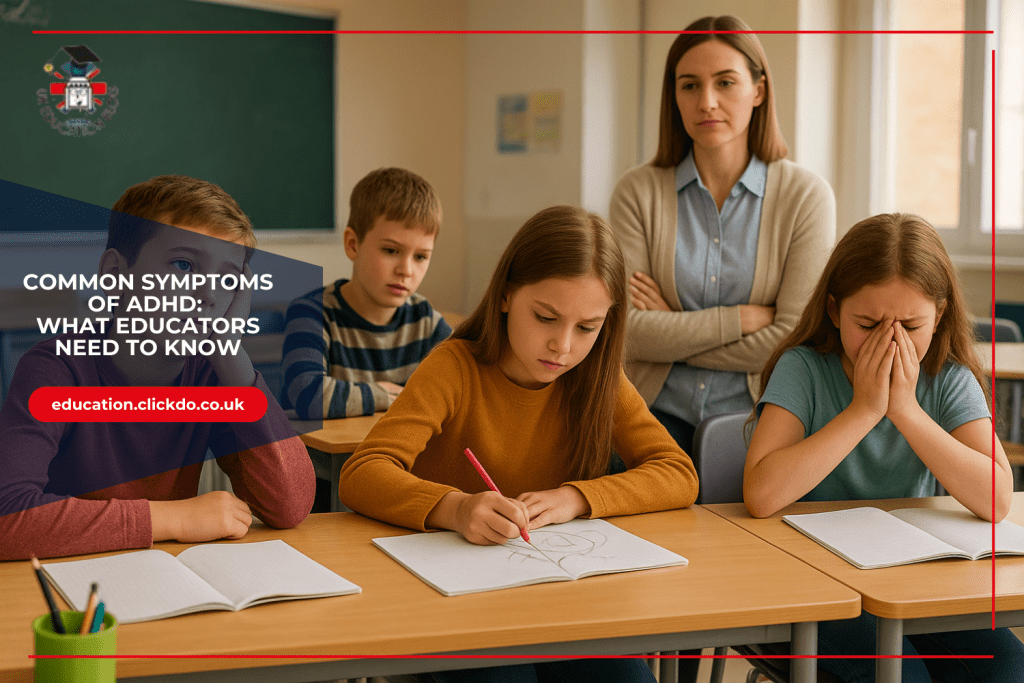
Understanding the common symptoms of ADHD in the classroom is really important for teachers.
While ADHD is often associated with hyperactivity or distractibility, the reality is far more nuanced. Many pupils mask their learning difficulties well, while others present in ways that can be misunderstood as behavioural issues rather than unmet needs.
Below are the key signs educators commonly notice in school settings, along with context that helps distinguish ADHD from typical classroom challenges.
1. Difficulty sustaining attention


Students may:
- Drift off during lessons, even when they are trying to focus
- Miss key instructions or only complete part of a task
- Appear to understand material in one moment and forget it the next
Lots of students may show these symptoms, but it is the severity of this that should be watched. Fundamentally, it’s difficult with the brain’s attention control systems.
2. Executive function challenges
ADHD strongly affects planning and organisation. Common indicators include:
- Losing worksheets, books, or equipment
- Difficulty breaking down multi-step tasks
- Struggling to start assignments independently
- Forgetting deadlines, homework, or important details
These pupils often know what to do but struggle to turn intention into action.
3. Restlessness and physical movement

ADHD can present as:
- Constant fidgeting, tapping, or shifting in seats
- Frequent trips out of the classroom
- Difficulty sitting for extended discussions
Movements like this help regulation rather than signalling defiance.
4. Impulsivity
This may look like:
- Calling out answers
- Interrupting teachers or peers
- Taking quick actions without considering consequences
Impulsivity is rooted in the brain’s regulation systems, not deliberate rule-breaking. This may be seen as bad behaviour if you are not aware of the symptoms.
5. Difficulty regulating emotions
Students may:
- Become overwhelmed quickly
- Experience frustration during challenging tasks
- Have sudden mood shifts
- Find it hard to calm down after becoming upset
Emotional regulation is a core component of ADHD but is often overlooked in schools.
6. Hyperfocus


One of the most misunderstood signs. Pupils may:
- Become deeply absorbed in a task they enjoy
- Lose track of time
- Struggle to switch to a new activity
Hyperfocus can be mistaken for inconsistency, but it is part of ADHD’s attention pattern.
7. Sensory sensitivity
Some pupils may:
- Be distracted by background noise
- Find busy environments overwhelming
- React strongly to textures, lights, or sounds
This can affect concentration and behaviour more than expected.
8. Social difficulties


ADHD symptoms can manifest in peer interactions, such as:
- Interrupting conversations
- Missing social cues
- Struggling with turn-taking
- Feeling left out or misunderstood
Many children with ADHD want friendships but find the social demands draining.
9. Low self-confidence or “I can’t do it” mindset
Over time, repeated challenges can impact self-esteem. Students may:
- Avoid tasks that feel overwhelming
- Downplay their abilities
- Expect to fail even before starting
Early recognition and support can prevent this pattern from deepening.
Why early identification matters in education
When educators understand these signs, schools can:
- Provide earlier interventions
- Reduce unnecessary behaviour sanctions
- Offer targeted support that improves learning outcomes
- Strengthen communication between home and school
- Prevent students from developing long-term academic anxiety or avoidance
- Getting a clear diagnosis can provide clarity and accurate medicine
ADHD is not a reflection of intelligence or potential. With the right support, students often show remarkable creativity, resilience, and problem-solving ability. We have created a complementary ADHD test that you may use as an initial screening.
Author Profile


- Chief of Marketing
- As the Chief of Marketing at the digital marketing agency ClickDo Ltd I blog regularly about technology, education, lifestyle, business and many more topics.
Latest entries