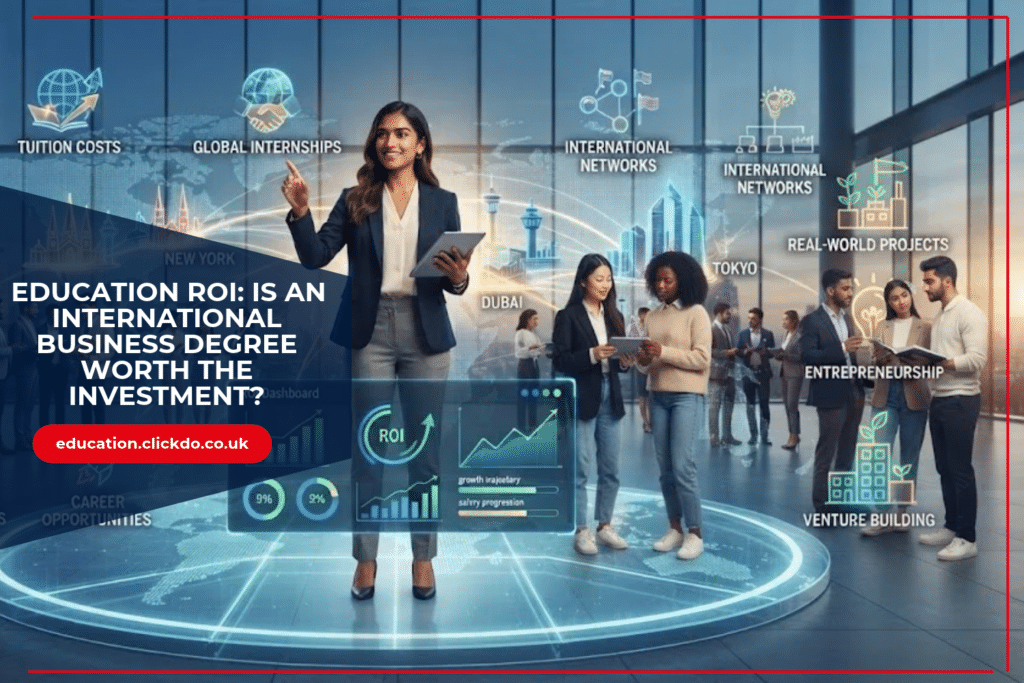
Choosing a degree is a massive gamble. Families spend hours staring at tuition fees, living costs, and the risk of a huge investment of time and money.
When you add multiple borders to the mix, the math gets messy. Suddenly, the actual cost of studying abroad isn’t just tuition fees; it includes flights, visas, health insurance, and more.
But let’s be honest: sitting on a single campus cannot give you global instincts that an international business degree can.
So, is it worth the money? There is no single answer. The best approach is to break down what the program actually gives you and see if it aligns with where you want to end up.
Forget the Brochure: Look at the Real Price Tag


Evaluating education ROI means getting incredibly real about the numbers. Stop looking at the glossy tuition page. You must map out the complete cost of studying abroad, including daily groceries and transit in expensive tech hubs.
Comparing schools based on base tuition is a trap. Figure out the total financial outlay first, then weigh it against the actual network you are buying into.
How Scholarships Completely Flip the Math
Financial aid can rewrite the economics of a global program. Thankfully, top schools routinely offer merit-based scholarships for international students who show real entrepreneurial grit or high academic drive.
Never assume you must pay the full price. Some offer a scholarship evaluation in their admission procedure. If you are building a ROI spreadsheet, tracking down these scholarships for international students should be your day-one priority.
The Real Career Outcomes After an International Degree

A degree is only worth the doors it actually unlocks. A global curriculum can land you fast-paced roles in venture capital, fintech, consulting, or growth marketing. But a piece of paper guarantees nothing. The actual differentiator is real-world experience.
Graduates win when they can show concrete projects built across different global markets. Ultimately, your career outcomes after an international degree depend entirely on this execution. Companies don’t just hire degree holders anymore; they want professionals with actual ground experience.
Does Global Exposure Actually Move the Needle on Employability?

Just living in another country is not an automatic career cheat code. Your actual employability after your degree depends on what you built while you were there. Securing a strong salary after an international business degree often requires evidence that you can apply what you have learned.
For instance, pitching a localized strategy to a live business in a foreign market proves you have adaptability, market knowledge, and other relevant skills needed to grow a business.
Proof of groundwork is worth more than a paper degree to companies today. This has pushed students to invest in a degree that provides international exposure with credible experience.
Global Internships Offer Serious Leverage

Internships bridge the gap between classroom theories and a real paycheck. Securing global internship opportunities gives you early access to different corporate cultures and markets. It helps you to realize how fast business rules change between regions.
Tetr’s undergraduate model leans heavily into this by embedding mandatory global internship opportunities right into the curriculum across multiple continents. The value is the functional business acumen you gain.
Why Venture-Building Changes the ROI Equation
Most degrees measure success at graduation. A venture-building model measures it constantly, term by term. At Tetr, for example, students don’t just study a market, they launch inside it, chasing real revenue targets or user numbers before moving to the next country and doing it again.
That repetition is what actually shifts the ROI math: instead of one thesis project at the end of four years, a graduate walks away with several real, measurable outcomes tied to their name. Employers aren’t guessing whether the degree translates into ability. There’s already a track record to check.
Measuring Return Beyond the Paycheck
The true ROI of an international business degree cannot be reduced to a starting salary. Money matters, but you are also investing in a lifelong global network, operational independence, and cross-cultural resilience. For a career built to span multiple markets, those capabilities are priceless. The question isn’t just whether global education costs more; it is whether that extra investment builds the exact life you want.
Author Profile


- Passionate education content creator and designer, contributor, writer and content marketing allrounder.
Latest entries