Most organizations bring in an LMS consultant after something has already gone wrong.
The implementation took twice as long as planned. The platform doesn’t do what the sales demo suggested. The integrations with HR and compliance systems were scoped out of the initial budget and are now blocking every other initiative. The vendor’s professional services team has moved on to the next client.
This sequence is common and largely preventable. Most LMS implementation problems are not technical problems. They’re scoping, architecture, and vendor selection problems — decisions made before any code is written — that become technical problems because no one with the right expertise was in the room when they were made.
What LMS Consultants Actually Do


LMS consulting is a broad term that covers several distinct types of work. Understanding which type you need is the first step in finding the right kind of help.
Platform selection consulting helps organizations define requirements and evaluate vendors before making a decision. This sounds like it should be straightforward, but vendor demonstrations are optimized to look impressive, not to surface limitations.
A consultant who has implemented the same platforms multiple times across different organizations know where the gaps are, which limitations the sales team will minimize, and which requirements will require expensive customization to meet. The selection decision is where the most expensive mistakes are made, and it’s the stage where experienced outside perspective has the most leverage.
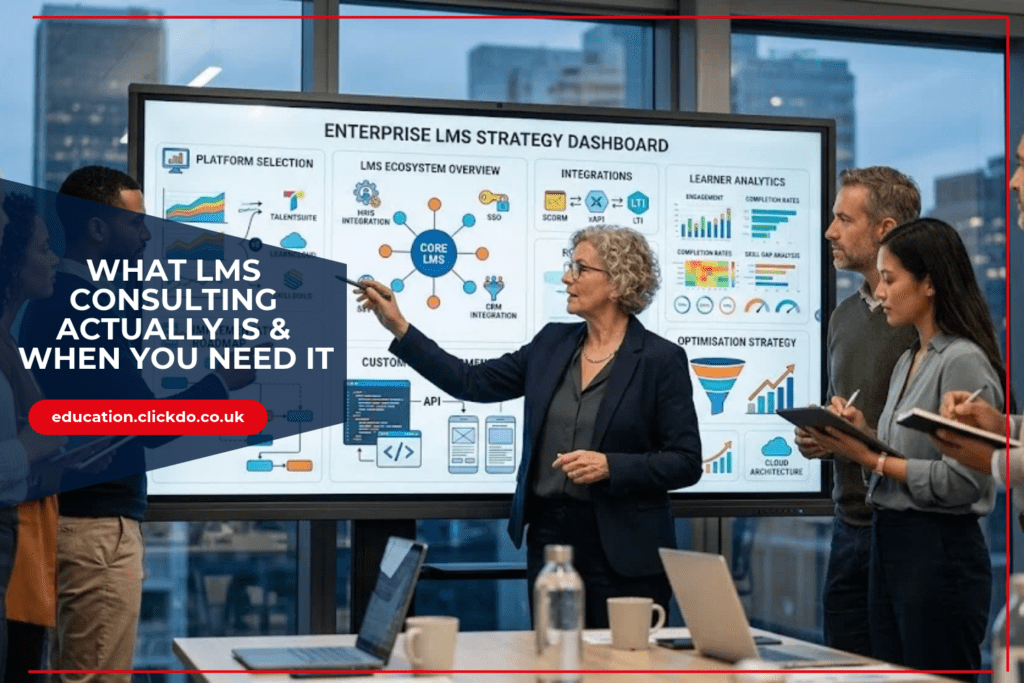
Implementation consulting covers the architecture, configuration, and integration decisions that determine how well the platform performs in production.
Which data flows between the LMS and the HRIS, how often, and in which direction?
How is single sign-on configured, and how does it interact with the organization’s identity provider?
What is the content authoring workflow, and how does it connect to the platform’s publishing infrastructure?
These decisions compound — a poorly designed integration architecture in month two becomes the technical debt that blocks every new feature for the next three years.
Optimization consulting applies when the platform is already in production and performance is falling short of expectations. Low completion rates, poor learner adoption, reporting that doesn’t give stakeholders the data they need, integrations that require ongoing manual intervention — all of these are symptoms that point to specific underlying decisions that can be identified and addressed without replacing the platform.
The Vendor Selection Problem

Scalability claims are particularly difficult to assess. Most platforms perform well in demonstrations and in production environments with controlled traffic. Performance under real load — enrolment periods, live event peaks, concurrent video streaming — is different, and the failure modes are predictable to anyone who has operated these systems at scale.
Integration depth is another area where surface-level evaluation misleads. Vendors describe integrations with Workday, Salesforce, and BambooHR as if all integrations are equivalent. In practice, an integration can mean anything from a native bidirectional sync that handles complex field mapping and error recovery to a pre-built connector that transfers a limited set of fields in one direction on a daily schedule. The difference between these is significant in operational terms, and it’s not visible in a product comparison matrix.
Standards compliance, such as SCORM, xAPI, LTI 1.3, OneRoster, requires the same scrutiny. A platform that claims SCORM support may handle SCORM 1.2 without supporting SCORM 2004 or may support the standard in ways that create problems with specific authoring tools. LTI 1.3 implementation quality varies significantly between platforms, and the differences show up as integration failures with content providers and partner systems.
Aristek Systems provides LMS consulting services covering platform selection, implementation architecture, and integration design — with 23+ years of EdTech experience across custom LMS development, Moodle, Canvas, Schoology, and the integrations that connect them to enterprise systems.
When the Platform Is the Wrong Question
A significant portion of LMS consulting engagements reveal, at some stage, that the platform is not the primary problem. The implementation was fine. The platform is capable. The gap between expected and actual outcomes traces to decisions about content, learning design, or data architecture that no platform can compensate for.
Content structure is frequently the issue. Organizations migrate a library of hour-long eLearning courses built for in-person training into a self-paced digital format and discover that completion rates are poor. This is a content design problem, not a platform problem. Chunking content into shorter segments, adding checkpoints that reinforce learning, and building assessments that measure understanding rather than recall — these changes happen at the content level and have more impact on learner outcomes than platform configuration.
Data architecture is the other common culprit. Organizations that have been running an LMS for several years often have completion data, assessment data, and engagement data that has never been systematically analysed.
A consulting engagement that surfaces what the existing data says about learner behaviour and content effectiveness — before any platform change — frequently identifies improvements that can be made without any migration or new implementation.
The Build vs. Configure Decision

The most consequential question in LMS consulting is often where the line falls between configuring an existing platform and building custom functionality. Both have costs: configuration has limits, and custom development has maintenance overhead.
Getting this decision right requires understanding both what the platform can actually do — not what it claims to support, but what it delivers in practice — and what the organization’s requirements actually are. Requirements elicitation in LMS projects is frequently where the most time and money is lost, because the stakeholders who will use the system and the stakeholders who are buying it often have different and sometimes contradictory needs.
A consultant who has navigated this decision across multiple organizations and platforms brings a calibrated sense of where the configuration ceiling is, what custom development actually costs to build and maintain, and which requirements are worth bending to the platform’s native capabilities versus which are worth investing in custom solutions. That judgment is what separates an LMS consulting engagement that produces a working system from one that produces a longer requirements document.
Author Profile


- Passionate education content creator and designer, contributor, writer and content marketing allrounder.
Latest entries