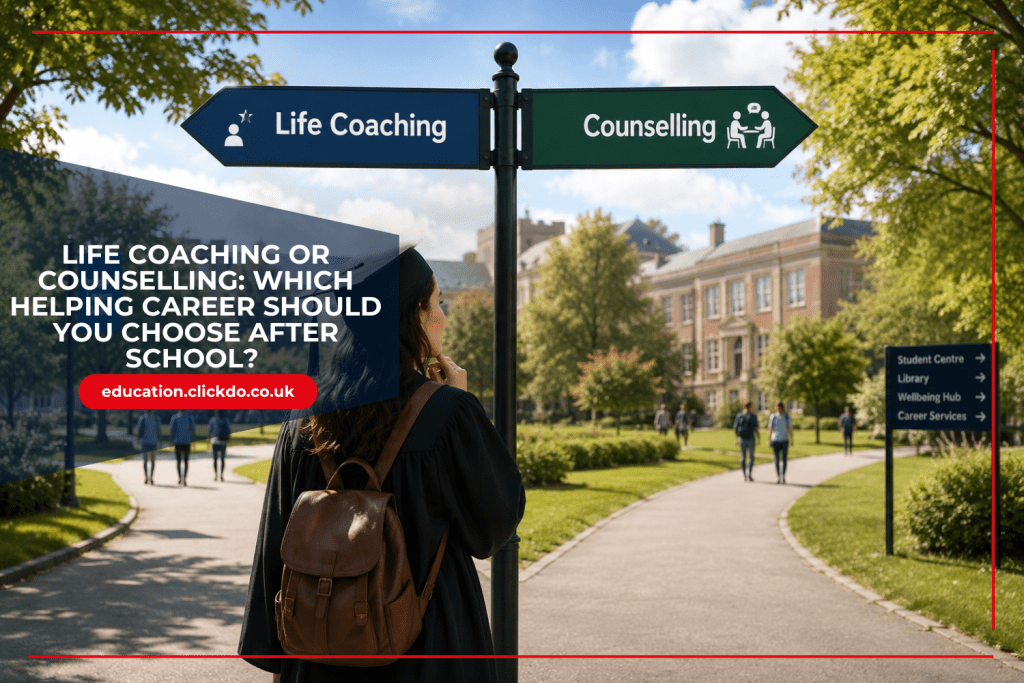
If you’re the kind of person whose friends always turn to for a good chat, the one who listens properly and genuinely cares, you’ve probably wondered at some point whether you could turn that into a career and what kind of career path would be suitable.
What are the Options and what’s the Difference?


The experts at The Coaching Academy know that the answer – and that there are two distinct, well-established paths that could suit you. The trouble is they look almost identical from the outside, so it’s worth understanding where they actually differ before you commit to either one.
The simplest way to think about it is this: counselling looks backwards, while coaching looks forwards.
Counselling helps people understand how their past shapes their present. It’s about healing, making sense of difficult feelings, working through the emotional fallout of hard experiences. If someone is struggling with anxiety, depression, grief, or the long shadow of a difficult childhood, a counsellor is who they’d turn to.
Life coaching is future-focused. A life coach works with people who are generally doing okay but feel stuck, unfulfilled, or unsure where they’re headed. Where counselling asks “what happened to you, and what does it mean?”, coaching asks “where do you want to go, and what do you do next?”
Neither one is “better” than the other – they simply serve different people with different needs.
What Does a Counsellor Actually Do?

A counsellor gives clients a safe, confidential space to explore difficult feelings and experiences: things like anxiety, depression, relationship problems, trauma, low self-esteem, or grief. The job isn’t to give advice or tell people what to do. It’s to help them hear themselves more clearly, understand their own patterns, and find their own way forward.
In practice, counsellors work in government sectors, schools, universities, GP surgeries, charities, the NHS, addiction services, hospices, and private practice. The NHS has been growing its counselling workforce, and the government has plans to expand it further over the coming decade, so job prospects for qualified counsellors are genuinely solid.
The work is emotionally demanding; sessions can be heavy, and you need good boundaries, regular supervision, and a real willingness to keep examining yourself as a practitioner. For the people who are drawn to it, however, there’s very little else that compares.
What Does a Life Coach Do?

A life coach works with people who are fundamentally doing fine but want: more direction, more confidence, more progress on things that matter to them. Career changes, work-life balance, building self-belief, improving relationships, finding a clearer sense of purpose. These are the bread and butter of coaching.
Sessions are active and forward moving. You ask pointed questions, help clients name what’s actually holding them back, and hold them to the actions they’ve committed to. Many coaches work online and build their own practice from scratch. Executive coaching in particular pays well.
That momentum is part of the appeal, but the flip side is that building a client base falls entirely to you.
What Training Will You Need?
This is where the two paths are most different.
Counselling Training

Becoming a counsellor takes time. The BACP (British Association for Counselling and Psychotherapy) recommends a three-stage route that typically runs to three or four years.
Stage one is a Level 2 Award: an introductory counselling skills course, usually eight to twelve weeks at a local college. This is a low-risk way to see whether the work actually resonates with you before committing to anything bigger.
Stage two is a Level 3 Certificate, which goes deeper into counselling theory, ethics, and self-awareness.
Stage three is the Level 4 Diploma in Therapeutic Counselling: the core professional qualification, studied part-time over about two years. It requires a minimum of 100 hours of supervised client work, along with academic study, personal development, and on most courses, your own therapy as part of the training.
Once you’re qualified, you’ll register with BACP, NCPS, or UKCP, and take on ongoing supervision and CPD as a permanent fixture of your working life.
The length and depth of the training exists for a reason. You’ll be sitting with people in genuine distress, and the programme is built to prepare you as a person, not just give you a set of techniques.
Life Coaching Training
Coaching is unregulated in the UK. There’s no government-mandated qualification and nothing legally stopping someone from calling themselves a coach without any training at all. This is a real problem in the industry, and worth knowing about.
In practice, coaches who take the work seriously train with providers accredited by recognised voluntary bodies, mainly the ICF (International Coaching Federation), the EMCC (European Mentoring and Coaching Council), or the AC (Association for Coaching). An ICF-accredited qualification can be done in a few months. The ICF’s entry-level credential requires 60 hours of coach-specific training and 100 hours of coaching experience.
The time and cost involved are much lower than for counselling, which depending on your circumstances can be a real advantage. The unregulated nature of the field also means the responsibility for your own ethical standards sits with you from day one.
The Ethical Line Between Them

One thing worth knowing clearly before you decide: coaching and counselling have a firm boundary between them, and crossing it causes real harm.
Coaching is for people who are stable enough to set goals and work towards them. It’s not a treatment for mental health problems. If a coaching client starts showing signs of depression, anxiety, or trauma that needs proper therapeutic support, a responsible coach recognises that and refers them on.
So if you’re drawn to working with people who are genuinely struggling, who carry difficult pasts, who need more than forward momentum, counselling is the right path.
Coaching is for people who are ready to move; counselling is for people who first need to understand where they’ve been.
Which One Sounds Like You?
Picture yourself ten years from now, in a session with a client.
Are they talking about what happened to them? The weight they still carry, the feelings they can’t quite name, the patterns that keep repeating? Are you helping them make sense of it all? If so, that’s counselling.
Or are they talking about where they want to go? The career they’re trying to build, the life they want to have, the person they’re working to become? Are you the one helping them get there? That’s coaching.
A few other things to weigh up. Counselling tends to suit people who are genuinely curious about psychology and human development, who can sit comfortably with uncertainty and slow progress, and who want the relative security of working within a professional structure that includes the NHS and other healthcare settings. It asks for three to four years of training before you practise independently.
Coaching tends to suit people who get restless if things aren’t moving, who have a specific area they want to work in, and who like the idea of running something that’s entirely their own. You can be working with clients within months.
Where to Start
If counselling is pulling at you, the BACP website is worth a look. Search for Level 2 introductory courses at colleges near you: many run in the evenings, and they’re low-cost enough to try before you commit to anything longer.
If coaching feels more like your thing, look for training providers with ICF or EMCC accreditation. Think about whether you have a natural area of focus, whether that’s careers, confidence, life transitions, or something else, because having a niche makes building a practice a lot easier.
If you’re genuinely not sure yet, that’s fine. Some people do a short introductory course in one and know immediately. Others take longer. What usually doesn’t help is waiting for certainty before doing anything at all.
If you’re reading this article, you clearly care about people, and both paths are a real way to make that useful.
Author Profile


- Shirley Owen is a blogger and writer who enjoys writing blogs on education, technology and general news. An avid reader, she follows all the latest news & developments to report on them through her articles.
Latest entries