

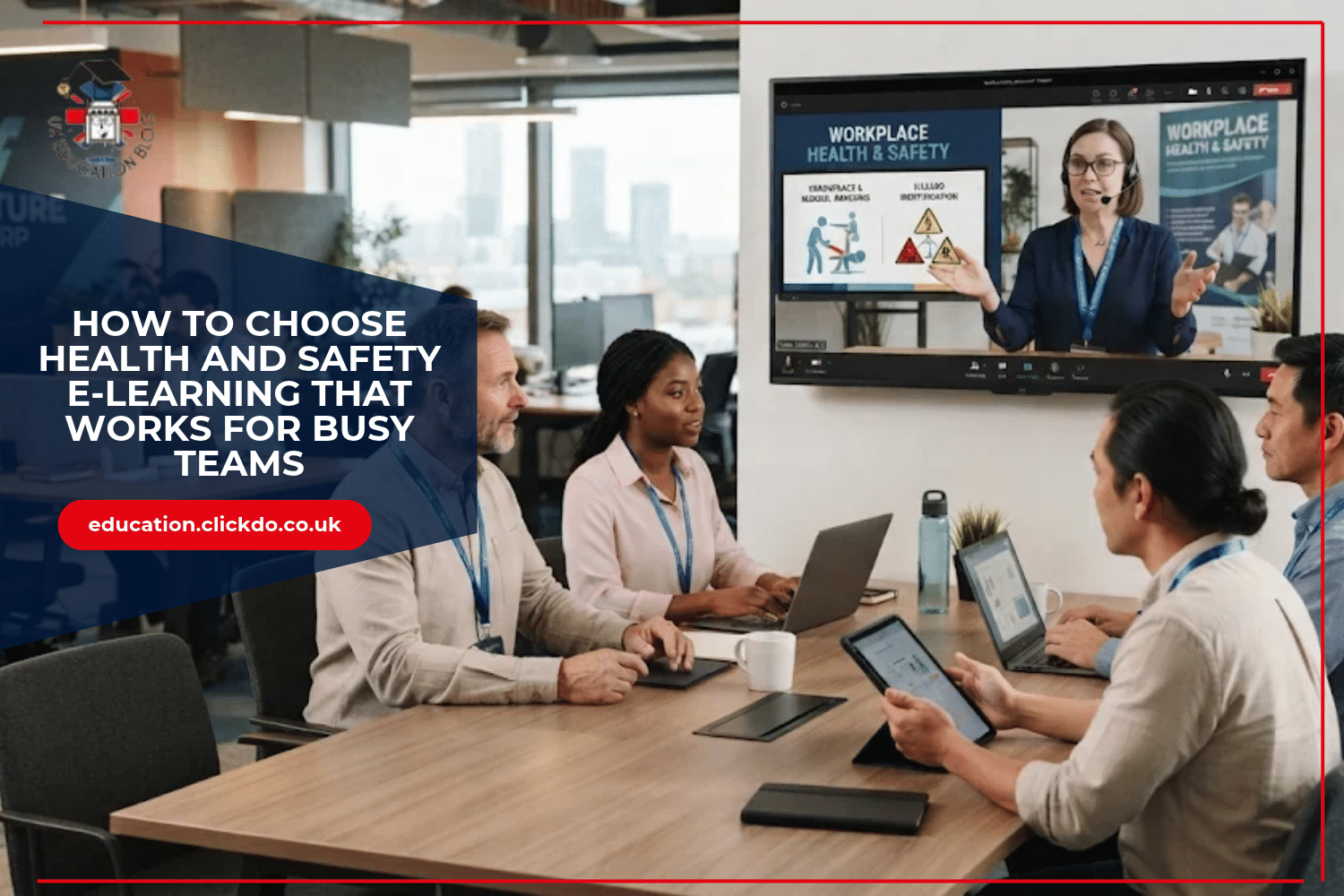

Effective health and safety e-learning starts with a clear decision about what staff need to know and what they need to practise.
Online modules can help busy teams learn theory around shifts and locations, but completing a module does not, by itself, demonstrate that someone can perform a practical task safely.
L&D leads should assess the learning goal, test the course with real users and add guided practice where the work calls for it.
What should health and safety e-learning actually teach?
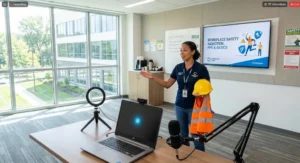
Before comparing courses, define the change expected in a learner’s working day. Is the aim to recognise a hazard, understand a procedure, make a decision or carry out a physical task? Short explanations, relevant scenarios and checks of understanding can work well online when the goal is to build knowledge. A manager could, for example, ask staff to work through a scenario about identifying a workplace risk before discussing what they would report or do next.
That distinction matters because “training completed” can describe very different achievements. A quiz may show that someone understands the steps in a procedure; it cannot show how they move equipment, respond during an emergency or adapt a technique to an awkward space. Write the learning goal in terms of the work itself, then ask what evidence would give a supervisor confidence that it has been met. This makes it easier to choose between self-paced study, a guided session and practical observation without expecting one format to do every job.
When does online learning work well for busy teams?

Self-paced theory is useful when people need access to the same core information but cannot easily leave their shifts or travel to one venue. A well-organised course lets staff pause between topics, return to a difficult explanation and study when they have a suitable window. This can be especially helpful for teams spread across several sites, provided managers make time for learning rather than treating it as something to squeeze into a break. Content should be divided at sensible points so an interrupted learner can find their place again.
Course choice still needs to begin with the task, not the convenience of delivery. Solutions Training & Advisory Ltd is a specialist training provider whose workplace health and safety e-learning sits alongside instructor-led and blended training formats. For a buyer, the useful question is whether a particular online course covers the knowledge staff need in their roles, with examples they can recognise from their working environment. A generic overview may be enough for an introductory topic; it may be too distant from the work for a team handling people, equipment or changing situations.
When are practical sessions still essential?

Some learning goals involve actions that need to be seen, attempted and discussed. Moving and handling is a clear example: understanding a principle on screen is different from applying it with the equipment, space and people involved in a particular setting. Hands-on first aid skills likewise call for opportunities to practise and receive feedback. Where a role involves difficult conversations, guided scenarios can help staff try out their responses rather than simply selecting an answer in a module.
The practical element need not look identical for every team. A live video session may be useful for questions, discussion or a trainer’s demonstration, while physical techniques may need a suitable in-person setting and appropriate supervision. Ask who will observe the skill, what they will look for and how learners can correct mistakes before using it at work. Online theory can prepare people for that session by introducing terms and principles beforehand, leaving guided time for the parts that benefit most from practice. Research on practical training provides further context for that distinction.
How can organisations check accessibility and learner engagement before rollout?

A course that works on a procurement team’s laptop may be difficult to use on a shared device or a slow connection at another site.
Before assigning it widely, invite a small group representing different roles, shifts and locations to try the learning in realistic conditions.
Give them a clear route for reporting obstacles, including points where they could enter the course but could not comfortably complete it.
The pilot is a practical test of fit, not a substitute for asking individual staff what support they need.
- Check that staff can sign in and resume learning on the devices and connections they actually use.
- Ask whether instructions, navigation, audio and text are understandable and usable for the intended learners.
- Look for examples that reflect the decisions staff make at work, rather than relying only on definitions and recall questions.
- Find out where learners lose their place, rush through material or want an explanation from a person.
Engagement is easier to judge through specific feedback than through a completion count alone. Ask pilot learners which scenario helped them think about their job and which part felt remote from it. If staff repeatedly misunderstand a question, the wording or example may need attention; if they cannot find time to start, the scheduling plan may be the problem. Use those observations to adjust the course, the support around it or the time allocated before expanding the rollout.
How can blended learning support distributed teams?

Blended learning can separate the parts that people can study independently from those that benefit from a trainer or colleagues. A team across several locations might complete a common online introduction, then attend shorter guided sessions arranged around local shift patterns. Those sessions can focus on questions arising from the module, practise a relevant skill or explore how a principle applies at a particular site. Staff arrive with shared vocabulary, while the practical element remains connected to their work.
The mix should follow the learning goal rather than a fixed formula. Solutions Training & Advisory Ltd offers online courses, instructor-led classroom training, video-conferencing sessions and blended options, illustrating the range of formats an organisation can consider. A discussion-based session may suit one topic, whereas a task involving physical technique may call for supervised practice in person.
For distributed teams, identify early which elements must happen locally, who can deliver them and how staff on different shifts will have an opportunity to take part.
What belongs in a simple evaluation plan?
A useful plan can fit on one page. Start by recording the audience, the tasks covered and the knowledge or skills the training should develop. Next, match each goal to a format: independent theory, guided discussion or practical exercise. Name the person who will check the course on staff devices and invite a representative group to test its relevance. Finally, decide when managers and learners will give feedback after the training has been used at work.
Keep the evidence for each goal distinct. A record of online completion tells managers who finished a module; feedback from a practical session tells them something different about how a skill was attempted and where further support might help. If a pilot reveals access problems, resolve those before scaling up rather than asking staff to work around them. If learners understand the theory but struggle to apply it, reconsider the guided element instead of adding more pages to the module.
The best choice is rarely a blanket decision for or against online learning. Begin with the work staff must do, use e-learning where independent study helps them prepare, and preserve time for practice where performance needs to be observed. A small test with the people who will take the course can reveal whether it fits their devices, schedules and roles. That is a firmer basis for a wider training decision than convenience or a completion figure alone.
Author Profile

- Passionate education content creator and designer, contributor, writer and content marketing allrounder.
Latest entries
 careerNovember 23, 2026How to Choose Health and Safety E-learning That Works for Busy Teams
 Directory PostsNovember 13, 20266 Top Canadian Universities in Smaller Cities for International Students Planning to Stay in Canada
 Directory PostsOctober 20, 2026Top CMS & LMS Platforms for Educational Websites Compared – Magento, WordPress and Moodle
 distance learningSeptember 24, 2026Education ROI: Is an International Business Degree Worth the Investment?