

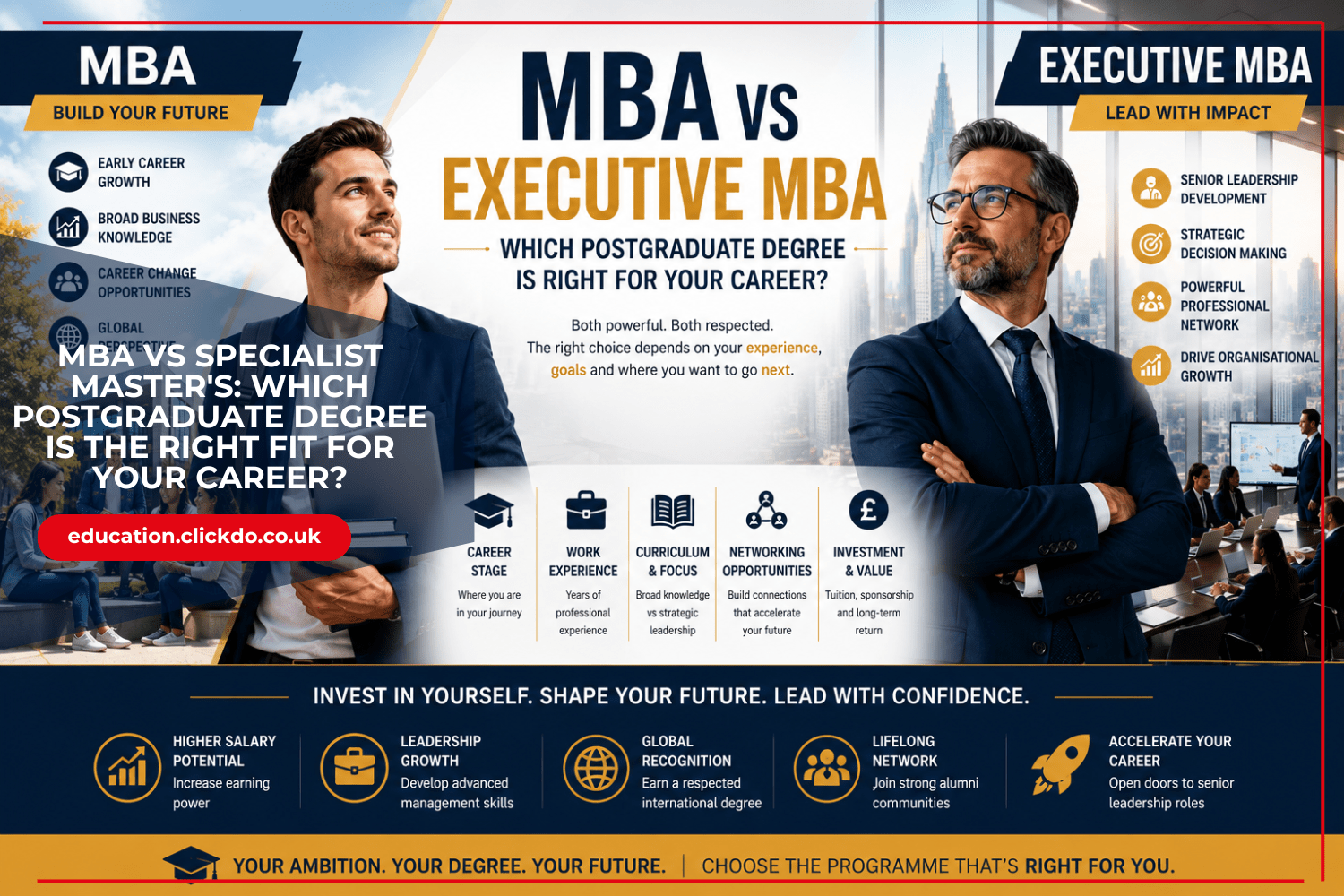

If you are a working professional considering your next academic step, the MBA vs master’s debate is likely one of the biggest questions on your mind.
Both qualifications are highly regarded postgraduate options. Both can influence your salary potential, career mobility, and credibility in the employment market.
There is no single option that is automatically better for everyone. The right choice in the MBA vs master’s decision depends on your current career stage, your professional ambitions, and where you want to be in the next five years.
This guide explains the key differences clearly so you can choose with confidence. It also covers the MBA vs MSc comparison, since a specialised Master of Science comes with its own benefits and considerations.
Let’s get into it.
The MBA at a glance: What it is and who it serves best

A Master of Business Administration is among the most recognised master’s degree qualifications worldwide. Traditional MBA programmes are built to give students a broad and practical understanding of essential business areas, including corporate finance, strategic marketing, human resources, project management, operations, and business strategy.
A full-time MBA is generally suited to early-career professionals or younger professionals who have around three or more years of work experience. These candidates are usually ambitious individuals who want to change industries, speed up their move into management, or build the management skills required to step into leadership responsibilities earlier in their careers.
Many MBA students choose to study full-time, allowing them to fully focus on academic study and the wider learning experience.
That said, many MBA programmes now offer more flexible options. These include blended programme formats, evening classes, weekend sessions, and part-time structures, making it possible for working professionals to earn a business degree without pausing their careers completely.
During the programme, you can expect to cover areas such as:
- Business administration and operations
- Financial analysis and corporate finance
- Strategic marketing and consumer behaviour
- Human resources and organisational behaviour
- Critical thinking and decision making
- International business and global perspective
For prospective students comparing an MBA with other postgraduate routes, the traditional MBA offers strong career prospects, a valuable professional network, and access to influential alumni networks that can continue to create opportunities long after graduation so find out if it’s worth pursuing.
What is an Executive MBA, and who should pursue one?

The Executive MBA, often called the EMBA, is a very different kind of postgraduate experience. Executive MBA programmes are designed specifically for experienced professionals, usually those with eight or more years in the workforce and substantial managerial experience already behind them.
These candidates are typically mid-career professionals or experienced executives who are already working at a senior level. They want to strengthen their strategic skills, develop their leadership skills further, and prepare themselves for the highest levels of business responsibility.
The Executive MBA programme is about reshaping how you lead.

Unlike a full-time MBA, the Executive MBA is built around the demands of senior professional life. Most EMBA programmes are delivered through weekend classes, intensive residential periods, or flexible study formats, allowing participants to keep leading teams and delivering results at work while studying. This programme format is designed for people who cannot, and often should not, step away from their organisations.
EMBA students bring years of real business experience into the classroom, and that is central to the value of the programme. The EMBA curriculum is designed for immediate application. Classroom discussions are more advanced, case studies feel more relevant, and the networking opportunities are especially powerful because participants are already in positions of influence.
Key differences between MBA and Executive MBA
Understanding the difference between an MBA and an Executive MBA is easier when you look at several core factors:
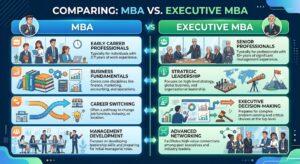
Career stage
This is the most important distinction. The MBA is aimed at professionals who are still in the earlier stages of their careers and want to develop a strong foundation in business administration. The Executive MBA is intended for professionals who have already built that foundation and are ready to operate at a more strategic, organisation-wide level.
Work experience
MBA programmes usually require around three years of professional experience. For the Executive MBA, most universities set a more advanced requirement, with candidates expected to be actively influencing company strategy at a senior level. Applicants should also have at least two years of P&L responsibility, or four or more years working as part of a team with clear P&L accountability.
Admissions criteria
The admissions criteria for an Executive MBA are typically more demanding when it comes to professional background and leadership exposure. Many organisations sponsor high-potential employees for EMBA programmes because they can see a direct and immediate return on that professional development investment.
Curriculum and focus
A traditional MBA gives students broad exposure to business management and core business functions. The EMBA curriculum, however, places greater emphasis on strategic decision making, leadership at scale, and managing complexity. It assumes students already have the professional experience needed to engage with the material in a more advanced and practical way.
Tuition costs and sponsorship
Executive MBA programmes often have higher tuition costs, but employer sponsorship is also much more common. Many companies fund an employee’s EMBA as part of a broader investment in leadership development and succession planning.
Networking opportunities
Both degrees provide valuable networking opportunities, but the type of network differs. EMBA programmes connect you with experienced professionals, senior managers, and executive-level peers, creating a network that can be immediately useful in real business situations.
Executive MBA vs MBA: Career benefits compared

The CEO of Achievable, Tyler York, believes both programmes can support meaningful career growth, but they are designed to serve different career objectives.
For someone earlier in their professional journey, an MBA can significantly accelerate career progress. It helps build management skills, clarifies career aspirations, and opens the door to roles that might otherwise require many more years of experience. MBA graduates often move into strategy, consulting, finance, and business management roles soon after completing their degree programme.
For experienced professionals, the Executive MBA offers a different type of value. It changes the way you think, lead, and make decisions. Career benefits at this level include preparing for senior leadership positions, taking greater ownership of your own business, and leading strategic decision-making at the highest levels of an organisation. The career trajectory moves from managing within a structure to leading with authority and vision.
In the competitive job market of the Middle East, where business schools are producing increasingly capable and globally minded graduates, the executive master’s qualification sends a strong message: you have not only studied leadership, but you have also already practised it.
How to choose: Questions to ask yourself
Still deciding between the Executive MBA and the traditional MBA? Tyler York said these questions can help you understand which path is better aligned with your goals:
Where are you in your career? If you are within the first five to seven years of your professional life, a full-time MBA or part-time programme may be the better fit. If you have eight or more years of experience and are already working in or close to management roles, the Executive MBA is likely designed for your stage.
What are your career goals? Are you trying to move into a new industry, or are you preparing to lead more effectively within your current one? Your answer will say a great deal about which programme is right for you.
Can your organisation benefit from what you learn? If the answer is yes, and for many Executive MBA candidates it is, employer sponsorship may become a realistic option.
What type of peer learning matters most to you? Learning alongside mid-career professionals and senior executives creates a very different classroom environment from studying with early-career professionals. Both experiences can be valuable, but they are not the same.
Choose the best Training for your Career Path
The Executive MBA vs MBA question does not have one universal answer. It does, however, have the right answer for your specific career stage, ambitions, and future plans. Whether you are still building momentum in the earlier years of your career or are an experienced executive preparing to lead at the highest level, many modern colleges offer a programme designed to help you move forward.
Frequently asked questions
1. What is the main difference between an MBA and an Executive MBA?
The main difference between an MBA and an EMBA is the career stage of the student. An MBA is intended for professionals in the earlier part of their careers who want to build a strong grounding in business administration. An Executive MBA is designed for experienced professionals with significant managerial responsibility who want to develop strategic leadership capabilities while continuing to work full-time.
2. Can I pursue an Executive MBA without employer sponsorship?
Yes. Although many Executive MBA programmes attract candidates who receive employer sponsorship, self-funded applicants are also welcome. The University of Manchester – Dubai also provides flexible payment options, including instalment plans, to support professionals who are funding their own studies.
3. How long does it take to complete an Executive MBA at The University of Manchester – Dubai?
The Global (Executive) MBA is an 18-month programme. It combines flexible learning with five global workshop residentials and face-to-face teaching, giving participants an immersive postgraduate experience without requiring them to take a career break.
4. Is work experience mandatory for MBA admission?
For The University of Manchester – Dubai’s Global MBA, applicants need a minimum of three years of work experience, evidence of strong career progression, and a recognised degree. The Executive MBA requires at least eight years of professional experience, along with significant managerial responsibility.
5. Will an Executive MBA help me move into senior leadership?
Yes. The Executive MBA programme is specifically structured to develop the strategic skills, leadership skills, and decision-making capabilities needed for senior leadership roles. Graduates of the Global (Executive) MBA programme often progress into organisational leadership, launch their own ventures, and take on board-level roles across different industries.
6. What is the difference in networking opportunities between an MBA and an EMBA?
Both programmes provide access to strong alumni networks and valuable networking opportunities, but the nature of those connections differs. MBA alumni networks are usually broad and varied across industries and career stages. EMBA alumni networks are often more senior, with participants and graduates already holding influential positions, making those connections highly relevant and immediately actionable.
Author Profile

- Passionate education content creator and designer, contributor, writer and content marketing allrounder.
Latest entries
 DictionaryOctober 8, 2026What Is a Digital Portfolio? Why It Matters and How Students Can Build One
  distance learningSeptember 24, 2026Education ROI: Is an International Business Degree Worth the Investment?
 Directory PostsSeptember 23, 202611 Best LMS Development Companies for Enterprise Online Learning Platforms
 ed techAugust 21, 2026What LMS Consulting Actually Is & When You Need It