


Your child comes home in Year 9 with an options booklet, and next to each subject there’s a little bracket: Biology (AQA), Maths (Edexcel), History (OCR). Most parents skim past it.
Then, around the spring of Year 11, you’re hunting for past papers at 10pm and suddenly that bracket is the only thing that matters.
An exam board is the organisation that writes the specification (the official list of what will be tested), sets the papers, marks them and issues the certificate. In England that mostly means three names: AQA, Pearson Edexcel and OCR.
WJEC runs a smaller fourth board called Eduqas. Independent and international schools often add Cambridge International, or Pearson’s own International GCSEs, to the mix.
Does it matter which exam board your child is on?
For the grade itself, no. Every GCSE board in England must cover the same government-set core content, and Ofqual, the exams regulator, keeps grading standards in line across boards. A grade 7 in AQA Biology is worth exactly what a 7 in OCR Biology is worth. What changes is the exam itself: the number of papers, the style of questions, and which past papers your child should be practising.
Who are the UK exam boards?
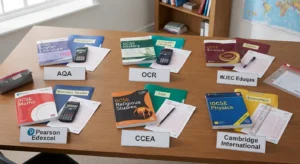
Five boards set GCSEs and A-levels across the UK. A sixth, Cambridge International, mostly serves independent and overseas schools. The shares below are each board’s slice of all GCSE certificates issued in England in the 2024 to 2025 academic year, from Ofqual’s latest market report.
| Board | Who runs it | Where you’ll usually meet it | Share of GCSE certificates in England (2024/25) |
|---|---|---|---|
| AQA | An independent education charity | Most state schools in England, especially for English and the sciences | 61.5% |
| Pearson Edexcel | Pearson, the education publisher | Very common for GCSE and A-level Maths, plus Edexcel International GCSEs abroad | 24.8% |
| WJEC / Eduqas | WJEC, based in Cardiff | The main board in Wales; sells into England under the Eduqas name | 7.1% |
| Cambridge OCR | Cambridge University Press & Assessment | Computing, the sciences, history and classics | 6.5% |
| CCEA | Northern Ireland’s exams council | Schools in Northern Ireland | Not in England’s figures |
| Cambridge International | Cambridge University Press & Assessment | Cambridge IGCSE and International A-levels in independent and international schools | Mostly outside England |
 That first row surprises most parents. Out of roughly 5.7 million GCSE certificates issued in England that year, more than six in every ten carried the AQA name. If your child’s school uses AQA for science, they’re in very large company. That’s useful, because the most popular specifications tend to have the deepest pools of past papers, textbooks and revision videos.
A-levels are more evenly split: AQA has 45.2%, Pearson 28.4% and OCR 20.2%. OCR does much better at sixth-form level than at GCSE. It’s the main board for Latin and classical civilisation, and it runs the well-known MEI maths course.
One small thing that confuses people: OCR changed its name to Cambridge OCR in September 2025. If your child’s certificate says Cambridge OCR and their old exam papers just say OCR, it’s the same board.
Scotland has its own system and national curriculum, with National 5s and Highers instead of GCSEs and A-levels, so most of this guide doesn’t apply there.
Is one exam board easier than another?
You’ll hear it at the school gate. “AQA is easier for science.” “Edexcel maths is a nightmare.” “OCR is the hard one.” Some of these opinions are based on real differences in exam style, but none of them means one board’s grade is cheaper than another’s.
There are two reasons. First, the content is fixed. Ofqual’s guide to grading, last updated in April 2025, puts it simply: every exam board must cover the same subject content and assessment objectives, and follow the same rules. The Department for Education sets what a GCSE in Chemistry must include, and AQA, Edexcel and OCR each build their own specification on top of that shared core.
Second, the grading is aligned. Each summer the boards use predictions based on students’ earlier results, and Ofqual checks every board against those predictions. Ofqual’s stated aim is that a grade should be no easier or harder to get with one exam board than with another.
This is where grade boundaries confuse parents. Picture two friends at different schools. One needs 62% for a grade 7 in GCSE Biology with one board; the other needs 70% with another. It looks unfair until you realise the boundaries move because the papers were different. Ofqual’s own explanation is that a higher boundary means that board’s paper was easier that year, not that its grade 7 is worth more. The bar moves so that the grade stays the same.
You’ll also see headlines showing one board with more top grades than another. That usually reflects who sits the exam. A board that is popular with selective and independent schools will naturally award more 9s, because more of its students were strong to begin with. Ofqual puts it plainly: outcomes by board may vary, but standards do not.
So, when a sixth form or university sees a 7, it reads it as a 7. They aren’t checking which board’s logo was on the certificate.
What actually differs between AQA, Edexcel and OCR?
The grade is equal. The experience of sitting the exam isn’t, and that’s where the board does matter for revision.
Take GCSE Maths. Edexcel’s version (spec code 1MA1) is three papers of 1 hour 30 minutes each: Paper 1 without a calculator, Papers 2 and 3 with one. AQA’s GCSE Maths has the same three-paper, non-calculator-then-calculator layout. The content is nearly identical. So why do students who switch boards say it feels like a different subject?
Mostly because of wording. Each board has its own habits: how much reading sits around a problem, how marks are split across a long question, which phrases signal “show your working”. A student who has done twenty Edexcel papers has absorbed those habits without noticing.
Science is where the differences get bigger.
- Paper count. AQA’s Combined Science (Trilogy) is six papers of 1 hour 15 minutes. OCR runs two separate science courses. Its Gateway Combined Science has six papers per tier; its Twenty First Century Combined Science has four, including one paper that mixes all three sciences.
- Practicals. Every board makes students do practical work, but they don’t call it the same thing or organise it the same way. AQA has “required practicals” (ten in GCSE Physics), Edexcel has “core practicals”, and OCR groups its practicals into eight “Practical Activity Groups” for Physics. If your child is on OCR and revising from a list of ten physics practicals, they’ve picked up an AQA list by mistake. It’s an easy mix-up to make.
In English Literature and History the differences are about content, not style:
| Subject | What every board shares | What changes by board |
|---|---|---|
| Maths | Same core content, three papers, one without a calculator | How questions are worded and how marks are split across long questions |
| Sciences | Same core topics and a set of compulsory practicals | Number and length of papers, practical lists, and OCR’s two separate courses |
| English Literature | Shakespeare, a 19th-century novel, a modern text and poetry | The poetry anthology and the list of set texts to choose from |
| History | A required spread of time periods and British history | The actual topics, so one board’s “medicine through time” unit may be another board’s “Weimar Germany” |
That last row catches families out every year. A Year 10 who moves house and changes school can find that half their History course has disappeared and been replaced by topics they’ve never seen. Nothing is wrong with either course. They’re just different courses.
Where does Cambridge IGCSE fit in?

This is the part that trips up families at independent schools, and anyone moving to or from the UK.
Cambridge IGCSE (from Cambridge International) and Pearson Edexcel International GCSE are international qualifications for 14- to 16-year-olds. They look like GCSEs and are a similar level, but Ofqual is clear that they’re different qualifications. A GCSE in England must follow content set by the government. An International GCSE doesn’t.
A few practical differences are worth knowing.
State schools in England have mostly stopped offering them. International GCSEs haven’t counted in school performance tables since the reformed GCSEs arrived (from 2017, subject by subject), so state schools switched away. In the UK, you’ll now mostly find them in independent schools. Back in 2018 they made up 45% of GCSE-level entries from independent schools in England.
The grades may be letters. Most Cambridge IGCSEs are still graded A* to G. Some regions, including the UK, can choose 9 to 1 grading, and the syllabus content is the same either way. Pearson’s International GCSEs use 9 to 1. If you need to compare, the anchor points the government used when GCSEs moved to numbers are a 7 for an A, a 4 for a C and a 1 for a G.
The tiers have different names. Cambridge IGCSE splits many subjects into Core and Extended papers. Edexcel’s International GCSEs, like regular GCSEs, use Foundation and Higher. Extended is the route to the top grades, so it’s worth checking which one your child has been entered for and checking early.
Do universities treat them differently? Cambridge says universities have committed to treating students equally whether their IGCSE grades are letters or numbers, and Pearson describes its International GCSEs as equivalent to UK GCSEs grade for grade. Ofqual is more cautious: it says the standards of the two can’t be compared with any precision. For applications, both are widely accepted, and what admissions teams look at is the grade.
How do I find out which exam board my child is on?
Ask the subject teacher or check the school’s curriculum page or exam timetable. Every paper on a GCSE timetable lists the board and a code. Before the summer exams, the school also gives each student a statement of entry showing every paper they’re entered for. Write the details down once and keep them somewhere you’ll find them in April.
The board name on its own isn’t enough. You want four things per subject:
- The board, for example AQA.
- The specification code, for example 8461 for AQA GCSE Biology, 1MA1 for Edexcel GCSE Maths, or J247 for OCR Gateway Biology. This is the single most useful detail, because it tells you exactly which past papers to download.
- The tier. In subjects like maths, the sciences and languages, Foundation papers cover grades 1 to 5 and Higher papers cover 4 to 9. A student who is aiming for a 7 must be on Higher.
- Combined or separate science. Combined Science gives two grades across biology, chemistry and physics. Separate (“triple”) science gives three. The papers are different lengths and cover different amounts of content.
If your child takes Cambridge IGCSE, add a fifth: Core or Extended, and whether their grades will be letters or numbers.
It takes ten minutes. It also saves a surprising number of evenings spent revising from the wrong specification.
How should knowing the exam board change revision?
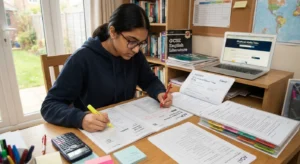
Here’s the mistake we’d most like parents to avoid: buying or downloading “GCSE Biology” revision material without checking it matches the board. Generic resources cover most of the shared core, but the gaps sit in exactly the places that cost marks: the practicals, the set texts, the History topics, and the way questions are phrased.
Once you know the board and spec code, a few habits make a real difference.
Use that board’s past papers, with its mark schemes. A past paper is only half the value. The mark scheme shows what the examiner was looking for, and boards differ in how precisely they want key terms used. Doing an AQA paper and marking it against an Edexcel-style answer is how students end up confused about why they “knew it” and still dropped marks.
Read the examiner reports. After each exam series the boards publish reports on how students did, question by question. They’re dry, but they list the mistakes that came up repeatedly. Twenty minutes with one of these before a mock is time well spent.
Keep notes tied to the specification. If your child’s notes follow the spec’s own topic list, they can tick topics off and see what’s left. When you’re looking for notes, check that they’re organised by board and spec rather than by subject alone. TutorKite, for example, sorts its revision notes and past papers by qualification and exam board, covering GCSE, IGCSE, A-level and more, so students only revise what their own exam will test.
Don’t try to change board. In a school, the board is chosen by each department, and students sit whatever their class is taught. Home-educating families are the exception: they choose the board themselves and should check early that a nearby exam centre will take private candidates for that specification.
If you only do one thing after reading this, find the spec code for each of your child’s subjects and write it on the inside cover of their planner. It sounds trivial. In May, it won’t be.
Frequently asked questions about UK exam boards
1. Can a school use different exam boards for different subjects?
Yes, and many do. Each department chooses the specification it thinks suits its students, so AQA science, Edexcel maths and OCR computer science on the same timetable is completely normal.
2. Which GCSE exam board is the hardest?
None, officially. Papers vary in difficulty from year to year and from board to board, but Ofqual lines up grade standards so that a grade is no easier or harder to get with one board than with another.
3. Is IGCSE harder than GCSE?
There’s no official answer. Ofqual says it isn’t possible to compare the standards of International GCSEs and GCSEs with any precision, mainly because it doesn’t have the earlier-results data on International GCSE students that it would need.
4. Do universities prefer AQA, Edexcel or OCR?
No. Universities and sixth forms look at the subject and the grade. The board doesn’t come into it.
5. Is Cambridge OCR the same as OCR?
Yes. OCR became Cambridge OCR on 8 September 2025, and certificates from the summer 2025 series onwards carry the new name.
6. Can my child practise with another board’s past papers?
For extra questions on shared topics, yes. For timed practice and marking, stick to their own board’s papers and mark schemes, because the structure and question style won’t match.
Author Profile

- Passionate education content creator and designer, contributor, writer and content marketing allrounder.
Latest entries
 ExamsNovember 26, 2026AQA, Edexcel, OCR or Cambridge? A Parent’s Guide to UK Exam Boards
 Directory PostsNovember 13, 20266 Top Canadian Universities in Smaller Cities for International Students Planning to Stay in Canada
 Directory PostsOctober 20, 2026Top CMS & LMS Platforms for Educational Websites Compared – Magento, WordPress and Moodle
 distance learningSeptember 24, 2026Education ROI: Is an International Business Degree Worth the Investment?