


Choosing what to study after GCSEs is an important decision for young people preparing for their next stage of education.
While A Levels and T Levels are already established options in England, students will soon have another pathway to consider.
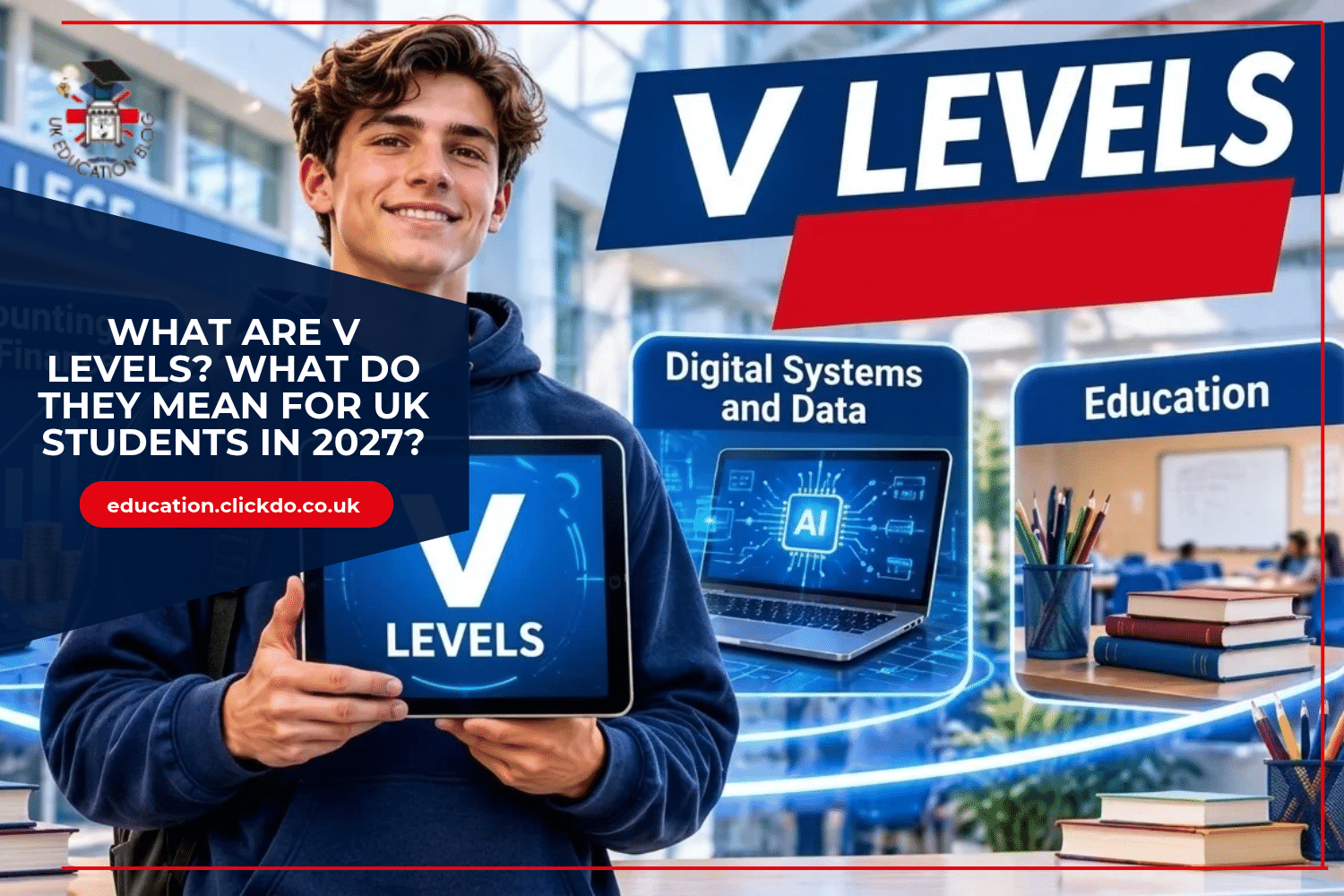
According to the Department for Education’s Post-16 Pathways Implementation Plan, the first V Levels will cover Accounting and Finance, Digital Systems and Data, and Education. Each qualification will contain 360 guided learning hours, making it equivalent in size to one A Level.
But what exactly are V Levels, how will they be assessed, and could they be the right choice for students preparing for their next stage of education?
What Are V Levels?
V Levels are new Level 3 vocational qualifications being introduced in England from September 2027. They are designed to provide broad, applied learning in particular subject areas, allowing students to explore different employment sectors while developing relevant knowledge and skills.
The Department for Education’s V Level proposals explain that these qualifications will form part of the reformed post-16 education system alongside A Levels and T Levels.
Unlike A Levels, which generally focus on academic subject knowledge, V Levels will emphasise applied vocational learning. They will also differ from T Levels, which provide more specialised technical programmes designed around particular occupational areas and include substantial industry placements.
According to Ofqual’s announcement confirming the new V Level regulations, each V Level will contain 360 guided learning hours, equivalent in size to one A Level.
This means students can combine V Levels with other qualifications, including A Levels, to create a study programme that reflects their interests and future ambitions.
The approach is intended to give young people more flexibility when choosing subjects after GCSEs, particularly those who want to explore a particular career sector before committing to a more specialised technical qualification.
Why Are V Levels Being Introduced?

The introduction of V Levels reflects changes in how young people approach education, skills development and future careers. Although traditional academic qualifications remain important, not every student wants to follow an entirely academic route after GCSEs.
Some learners prefer applied education that connects classroom knowledge with real-world industries. Others want to explore different career sectors before deciding which occupation or specialism to pursue.
Research published by the Department for Education in its guide to new V Levels and post-16 qualifications found that nearly half of surveyed parents of young people aged 14–18 preferred a combination of academic and work-based learning for their children after GCSEs. The same research highlighted that around a quarter of parents were not confident their children understood the options available after GCSEs.
These findings demonstrate the importance of providing clearer information and a wider choice of suitable qualifications for young people.
V Levels aim to address this by offering broad vocational subjects that allow students to develop knowledge across an employment sector without immediately specialising in one particular occupation.
The wider reforms also aim to create clearer progression opportunities into higher education, higher technical qualifications, apprenticeships and skilled employment.
Which V Level Subjects Will Be Available in 2027?
The first V Level qualifications are expected to begin teaching in September 2027. According to the Department for Education’s published V Level subject content, students will initially be able to choose from three subjects:
- Accounting and Finance: Introduces financial services, accounting, banking and business, providing a foundation for further study in finance and business-related subjects.
- Digital Systems and Data: Covers digital AI technology, computing, data and information systems, supporting students interested in technology-related education and careers.
- Education: Introduces learning, teaching and education, providing a starting point for students considering further study in teaching, childcare or learning support.
For students exploring alternative routes into employment, our article on High-Growth UK Careers That Do Not Require a Three-Year Degree provides further information about different career pathways.
As digital skills become increasingly important across industries, students may also benefit from exploring our guide to In-Demand EdTech Careers and Jobs in the UK.
V Levels vs A Levels vs T Levels: What Are the Main Differences?
Although A Levels, V Levels and T Levels are all Level 3 qualifications, they are designed around different learning approaches and progression opportunities.
A Levels generally suit students who want to develop academic knowledge in subjects such as Mathematics, English, Biology and History. T Levels provide a more specialised technical pathway, combining classroom learning with substantial industry placements. V Levels are intended to offer broader applied vocational learning across particular employment sectors.
According to the Department for Education’s post-16 qualification guidance, a V Level contains 360 guided learning hours, while a full T Level contains approximately 1,080 guided learning hours, making it equivalent in size to three A Levels.
The following comparison highlights the main differences:
| Feature | A Levels | T Levels | V Levels |
| Main focus | Academic study | Technical and occupational preparation | Applied vocational learning |
| Qualification level | Level 3 | Level 3 | Level 3 |
| Qualification size | 360 guided learning hours per A Level | Approximately 1,080 guided learning hours | 360 guided learning hours per V Level |
| Learning approach | Academic and subject-focused | Classroom learning and practical technical training | Vocational knowledge and applied learning |
| Industry placement | Not a standard requirement | Includes a substantial industry placement | No equivalent compulsory T Level-style placement |
| Subject choice | Wide range of academic subjects | Specific technical pathways | Broad vocational subject areas |
| Study combinations | Can be combined with other A Levels and suitable qualifications | Usually studied as a full technical programme | Can be combined with A Levels and other suitable qualifications |
| Progression | University and further study | Higher education, apprenticeships and skilled employment | Higher education, higher technical training and apprenticeships |
The most suitable option will depend on a student’s preferred learning style, interests and future ambitions.
For example, someone who enjoys academic study and wants to keep their university options open may prefer A Levels. A student interested in exploring a particular employment sector through applied learning could consider V Levels. Those who already have a clearer technical career direction may find T Levels more suitable.
Students should also consider the entry requirements of their preferred universities, colleges and training providers before choosing a qualification.
How Will V Levels Be Assessed and Graded?

Assessment is an important consideration for students comparing V Levels with existing qualifications. Rather than relying entirely on traditional written examinations, V Levels will use a combination of assessment methods to evaluate students’ knowledge and understanding.
According to Ofqual’s announcement confirming the new V Level regulations, the first V Levels will generally allocate:
- 40% of the overall marks to timetabled assessments.
- 60% of the overall marks to other forms of assessment.
Timetabled assessments may include written examinations and practical or applied tasks. The remaining assessment will depend on the subject and its qualification specification.
This approach is intended to allow students to demonstrate their understanding through different assessment methods rather than depending entirely on examination performance.
Ofqual has also confirmed the following grading structure:
- A to E:* Graded qualification results.
- P: Pass grade.
- U: Ungraded result.
The exact assessment content and arrangements will vary according to the subject. Students should therefore check the relevant qualification specifications when they become available.
Parents and students can consult Ofqual’s V Level requirements and guidance for the official regulatory framework and subject-specific information.
Will V Levels Be Worth the Same UCAS Points as A Levels?
One important development for students considering university is the recognition of V Levels within the UCAS Tariff.
According to UCAS’s announcement on V Level Tariff points, published on 17 September 2026, V Levels will receive the same UCAS Tariff points as A Levels at corresponding grades from A* to E.
The confirmed Tariff points are:
| V Level grade | UCAS Tariff points |
| A* | 56 |
| A | 48 |
| B | 40 |
| C | 32 |
| D | 24 |
| E | 16 |
| P | 12 |
These points provide a way for universities and colleges that use the UCAS Tariff to compare qualifications. However, receiving the same Tariff points does not mean every university or degree course will automatically accept every V Level subject. Universities can set their own admissions requirements, including specific subject combinations and qualification criteria.
In a written parliamentary answer published on 9 November 2026, the government confirmed that it is working with universities, Universities UK and UCAS to support recognition of V Levels.
The government has also stated its ambition for V Level students to have an equal likelihood of progressing to Level 4 or higher study compared with A Level students once the qualifications are fully established.
For students considering university, researching individual course entry requirements will therefore remain essential. Our guide to How to Get UCAS Points explains how the Tariff works and why universities may use it when assessing applications.
What Can Students Do After Completing a V Level?
V Levels are designed to give students different options after completing their qualifications. Depending on their interests and future plans, they may continue studying, gain technical skills or prepare for employment.
1. Go to University
Students may use their V Level results when applying to university. According to UCAS’s announcement on V Level Tariff points, V Levels will receive UCAS Tariff points matching A Levels at grades A* to E.
However, universities can set their own entry requirements, so students should check whether their chosen course accepts the relevant V Level.
2. Continue With Higher Technical Qualifications
Students who want to develop more specialised skills may progress to a Higher Technical Qualification (HTQ). These courses provide further technical knowledge and can help prepare learners for skilled jobs.
3. Start an Apprenticeship
Another option is to apply for an apprenticeship. Apprenticeships combine paid work with training, allowing students to gain practical experience while developing skills in a particular industry.
Opportunities may be available in areas such as business, finance, digital technology and education, depending on the employer’s entry requirements.
Finished your V Level and wondering what to do next? Explore the differences between Degree Apprenticeships vs University, and discover which route could best support your future career.
Watch our video for useful tips to help school leavers make informed decisions about their next steps!
4. Gain Further Training and Work Experience
Some students may need additional qualifications or workplace training before entering their chosen profession. V Levels provide a foundation for further learning, but they do not automatically qualify students for specialist jobs.
Watch our video to discover the different progression routes available after completing a V Level and how further education, training and practical experience can help students prepare for their chosen careers.
What Should Students and Parents Do Before Choosing a V Level?
With the first V Level qualifications expected to begin in September 2027, students and parents have time to research the new system and decide whether it suits their education and career plans.
According to the Department for Education’s Post-16 Pathways Implementation Plan, 70% of general further education colleges and 85% of sixth-form colleges have indicated plans to offer V Levels. However, course availability will vary between institutions.
Here are some practical steps to consider:
- Understand the three pathways: Compare A Levels, T Levels and V Levels before deciding which learning approach is most suitable.
- Research the available subjects: Start by exploring Accounting and Finance, Digital Systems and Data, and Education.
- Check sixth-form and college availability: Not every institution will necessarily offer all three V Level subjects when they are first introduced.
- Review university entry requirements: If university is a future goal, check whether preferred institutions accept the relevant V Level subject.
- Understand the assessment methods: Find out how examinations and other assessments contribute to the final qualification grade.
- Consider future career interests: Think about whether a broad vocational subject or a more specialised technical qualification would better support future ambitions.
- Speak to careers advisers: Ask teachers, college admissions teams and careers professionals for guidance before making a final decision.
- Follow official updates: Check government and Ofqual publications for the latest qualification specifications, assessment information and implementation dates.
Students preparing for their GCSEs may also benefit from additional academic support. Our guides on How to Choose the Right Online Tutor for GCSE and A-Level Success and Top GCSE Online Tutors in the UK offer further guidance for learners and parents.
For students working towards stronger English results, our article on GCSE English Literature Tutor: Tips for Achieving Grade 9 may also be useful. Those who want to strengthen their English and maths skills can explore Functional Skills Level 2 Exam Study Tips.
Many young people in the UK lack essential digital skills. Watch our video to discover how smart learning and practical training can help them build confidence and prepare for future careers.
Be Part of the Next Wave of Education
At the UK Education Blog, we are committed to highlighting the educational developments, student opportunities and policy changes shaping the future of learning in the UK.
Whether you are an educator preparing students for the new qualification system, a student exploring post-16 options or an education professional following vocational learning developments, your experiences and insights can contribute to the wider conversation.
Share your insights and success stories with our editorial team to be featured on our Trendspotter page. Let’s lead the conversation together—Get in touch with us today to have your voice heard!
Disclaimer: All information provided was correct at the time of publication and was collected with the help of accredited tools and real-world data insights.
Author Profile

- As a Marketing & Communications Strategist at ClickDo, I work remotely and regularly write blogs about education, technology, EdTech, the latest trends, education news and other interesting topics.
Latest entries
 DictionaryNovember 26, 2026What Are V Levels? What Do They Mean for UK Students in 2027?
 Directory PostsAugust 5, 2026Top 5 UK Education Podcasts