


UK businesses are adopting artificial intelligence, automation and data-driven tools at an increasing pace.
From AI features built into everyday software to more advanced business intelligence and automated workflows, new technology is changing how many employees work.
But introducing new technology is only part of the challenge. Employees also need the skills and confidence to use it effectively.
When people struggle to use new software or AI tools, the pressure often falls on internal IT teams and managers. They may find themselves answering basic questions, correcting errors, fixing reports or helping employees work around problems that could have been avoided with better training.
For businesses investing heavily in new technology, this can become an expensive problem. If employees use only the most basic features of a system, or avoid new tools because they don’t understand them, the organisation may not get the full benefit of its investment.
The solution isn’t necessarily more technology. In many cases, it is better training.
The Growing AI and Data Skills Gap

The rapid adoption of AI and workplace automation is creating new opportunities for UK businesses, but it is also creating new skills requirements.
AI can now help employees analyse information, create content, automate repetitive tasks and find useful insights in business data. Many familiar applications are also gaining AI-powered features so AI literacy is key. However, having access to these tools doesn’t automatically mean employees know when or how to use them effectively.
Employees need to understand not only how new tools work, but also how they can be applied to their own jobs. They also need to know when to check AI-generated results, how to work with business data safely and when a task still requires human judgement.
When these skills are missing, the effects can be felt throughout an organisation:
- Greater pressure on IT teams: IT departments may be diverted from important infrastructure and cybersecurity work to answer routine questions about software and new digital tools.
- More pressure on managers: Line managers can spend considerable time checking, correcting and formatting reports or helping employees with tasks they could otherwise complete themselves.
- Underused software and AI tools: Businesses may invest in powerful software and AI features but use only a small part of what is available.
- Slower adoption of new technology: Employees who are unsure how to use new tools may continue relying on familiar manual processes, reducing the potential benefits of automation.
Moving Beyond Generic Self-Paced Learning
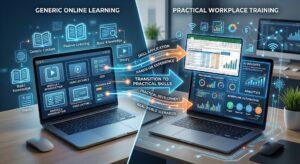
Many organisations use online videos and self-paced learning to help employees develop new skills. These resources can be useful, particularly for simple tasks, but they don’t always prepare people for the situations they encounter in their own jobs.
An employee may understand how a particular Excel function, Power BI feature or AI tool works in a training exercise but still be unsure how to apply it to a complicated spreadsheet, report or business problem.
Effective training should therefore connect new skills with real work.
Instructor-led training gives employees the opportunity to ask questions, work through realistic examples and get help when they encounter problems. It also allows an instructor to explain not just how a feature works, but when it is useful and how it can be applied to the employee’s own work.
This is particularly important with AI. Employees need more than an introduction to the latest AI tools. They need practical guidance on how those tools can improve their work, how to check the results they produce and how to combine AI with their own knowledge and judgement.
The result should be employees who can solve more problems for themselves, rather than employees who must rely on IT or their managers whenever they encounter something unfamiliar.
Practical Training for Different Roles
Different employees use technology in different ways, so training should reflect the roles people perform and the problems they need to solve.
Advanced Data Skills
Managers and operational staff increasingly need to work with business data themselves. Training can help them analyse, interpret and present information more effectively, reducing the need to rely on specialist colleagues for every report or analysis.
AI and Automated Workflows
AI and automation can remove many repetitive tasks, from preparing reports to working with spreadsheets and documents. Employees need to understand which tasks can be automated, how to use the available AI features and how to check the results before relying on them.
Project and Change Management
Introducing new technology often affects several teams at once. Team leaders need the skills to manage these changes, communicate effectively with different departments and keep projects moving while employees adapt to new systems and processes.
Role-Specific Software Skills
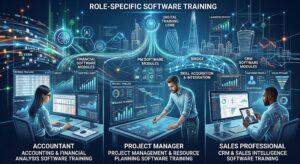
Employees also need training that reflects the software they actually use. For example, an accountant, project manager and sales professional may all use Microsoft Excel, but their requirements are very different. Training that reflects these differences is more likely to be useful when employees return to their desks.
To support UK organisations developing these skills, Infero Training provides flexible, hands-on training delivered virtually, in a classroom or through customised corporate workshops for example. Businesses looking to strengthen their analytical capabilities can explore specialised Data Analytics Courses, while broader teams can benefit from tailored instructor-led programmes covering Microsoft applications, AI, automation and other modern business tools.
The Business Case for Better Training
Good training isn’t simply about helping employees complete a course. The real benefit comes when they use what they have learned to work more effectively.
Organisations can look for practical improvements such as:
- Fewer routine IT requests: Employees who can solve more software problems themselves place less pressure on internal IT teams.
- Faster reporting: Better skills in Excel, Power BI and other data tools can help employees produce reports more efficiently.
- Greater use of existing software: Employees are more likely to use advanced features when they understand how those features can help them.
- More effective use of AI: Employees who understand both the opportunities and limitations of AI can use it more confidently and appropriately.
- Less reliance on manual processes: Automation and better use of software can reduce repetitive work and free employees to concentrate on more valuable tasks.
The aim isn’t to replace people with technology. It is to give people the skills to make better use of the technology available to them.
A Note about Infero Training
Infero Training is a UK-based professional development provider offering more than 450 instructor-led courses covering Microsoft applications, Data Analytics, Project Management and Professional Leadership.
Training is available through classroom courses, live virtual sessions and bespoke corporate programmes, with content designed around the practical needs of the people taking part.
By helping employees develop practical, job-ready skills, Infero Training helps organisations make better use of their existing technology, reduce pressure on internal support teams and give employees the confidence to work more effectively with modern business tools, including AI.
Author Profile

- Shirley Owen is a blogger and writer who enjoys writing blogs on education, technology and general news. An avid reader, she follows all the latest news & developments to report on them through her articles.
Latest entries
 careerSeptember 2, 2026The AI Skills Gap in UK Business: How Targeted Upskilling Relieves Strained IT and Management Teams
 learningAugust 21, 2026How to Choose the Right Online Tutor for GCSE & A-Level Success in the UK
 student lifeAugust 14, 2026The Student Wellbeing Handbook: Managing Health, Stress and the NHS at University
 ed techAugust 11, 20265 Best Tools For Students to Create Audio Slideshows and Presentations