

By Gerardo Bonilla, Co-founder & CEO of Temso AI
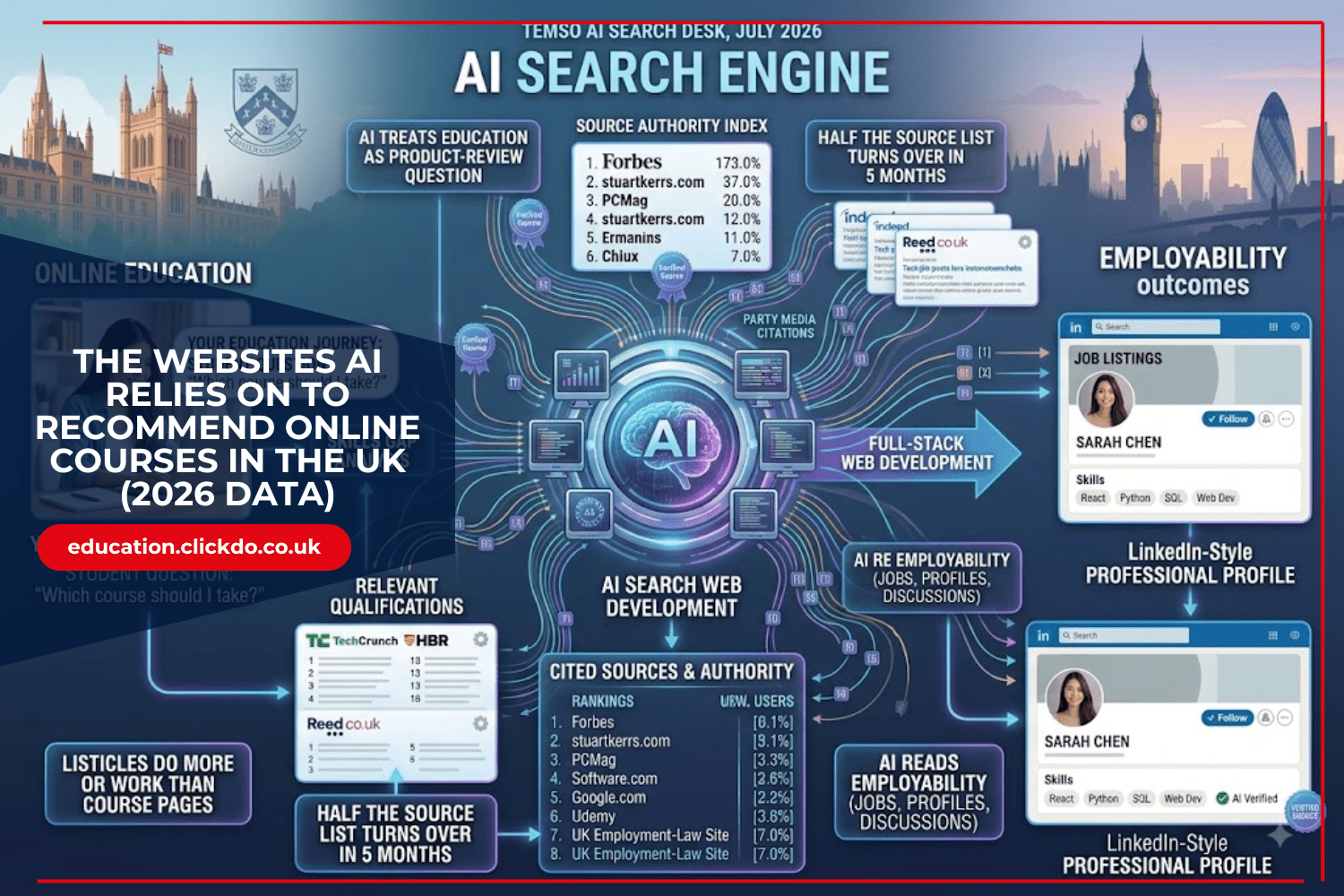
When someone asks ChatGPT, Google, Microsoft Copilot, or Grok where to study online in the UK, the answer isn’t written from scratch.
It’s assembled from sources. Those sources are measurable, and if you run an online education institution, they’re the most useful thing you can look at, because they’re the part of the system you can still get into.
The figures below come from Temso’s AI Search Desk, which led a proprietary study of online education in the United Kingdom. Every number is the share of relevant AI responses in which that source appears.
The picture they give is not what most education marketing teams expect.
The 10 sources AI cites most
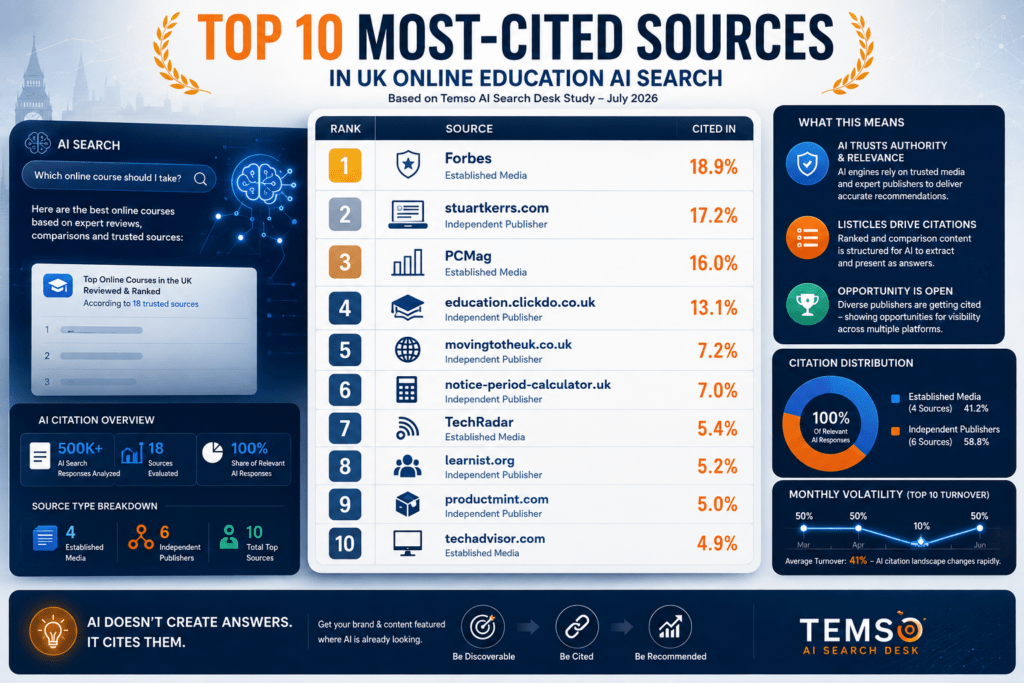
Most-cited sources, Temso AI UK online education report, July 2026
| # | Source | Cited in |
|---|---|---|
| 1 | Forbes | 18.9% |
| 2 | stuartkerrs.com | 17.2% |
| 3 | PCMag | 16.0% |
| 4 | education.clickdo.co.uk | 13.1% |
| 5 | movingtotheuk.co.uk | 7.2% |
| 6 | notice-period-calculator.uk | 7.0% |
| 7 | TechRadar | 5.4% |
| 8 | learnist.org | 5.2% |
| 9 | productmint.com | 5.0% |
| 10 | techadvisor.com | 4.9% |
Two things stand out.
The established media here are technology reviewers
Forbes, PCMag, TechRadar, and Tech Advisor. Not education press. No UK education title appears anywhere in the top 10: not Tes, not Times Higher Education, not the education desk of a national newspaper. AI engines are treating “which online course should I take” as a product-review question and reaching for the outlets that review products.
The other six are independent publishers
Specialist and niche titles rather than national brands. A UK employment-law site is cited in 7.0% of online-course answers, which puts it above TechRadar.
The common factor isn’t the size of the publisher. It’s the format. Most of the cited pages from these publishers are a numbered list that names specific options and compares them. A ranked list is already shaped like an answer, so an engine can lift it more or less intact.
Your course pages aren’t, however good they are, because there’s nothing in them to compare against anything else. What the data tells us is that the listicles these publishers are producing do more work than your own product pages.
The source list rewrites itself most months
Of the 10 most-cited sources in each of the five months of the study, only two appear in all five: Forbes and education.clickdo.co.uk.
Month over month, the top 10 retained 5, 5, 9, and 5 of its members. In three of those four transitions, half the sources feeding AI’s recommendations weren’t there four weeks earlier.
This is the finding that changes what you should do. A citation layer where eight of 10 positions turned over inside five months isn’t a fortress. Positions come open constantly. It also means nothing you win stays won so that a single placement won’t hold.
Does user-generated content play a role?
Alongside editorial sources, AI answers draw on communities, marketplaces, and directories. The July ranking for UK online education:
| # | Channel | Cited in |
|---|---|---|
| 1 | futurelearn.com | 25.6% |
| 2 | uk.indeed.com | 25.4% |
| 3 | 16.3% | |
| 4 | 14.9% | |
| 5 | coursera.org | 8.1% |
| 6 | Medium | 8.1% |
| 7 | cydozanim.com | 7.2% |
| 8 | YouTube | 6.5% |
| 9 | Class Central | 6.3% |
| 10 | GitHub | 5.3% |
A jobs board is the second most-cited channel in the category. Indeed, alone is cited more often than Forbes. LinkedIn and Reddit are each cited more often than every source in the editorial table below PCMag.
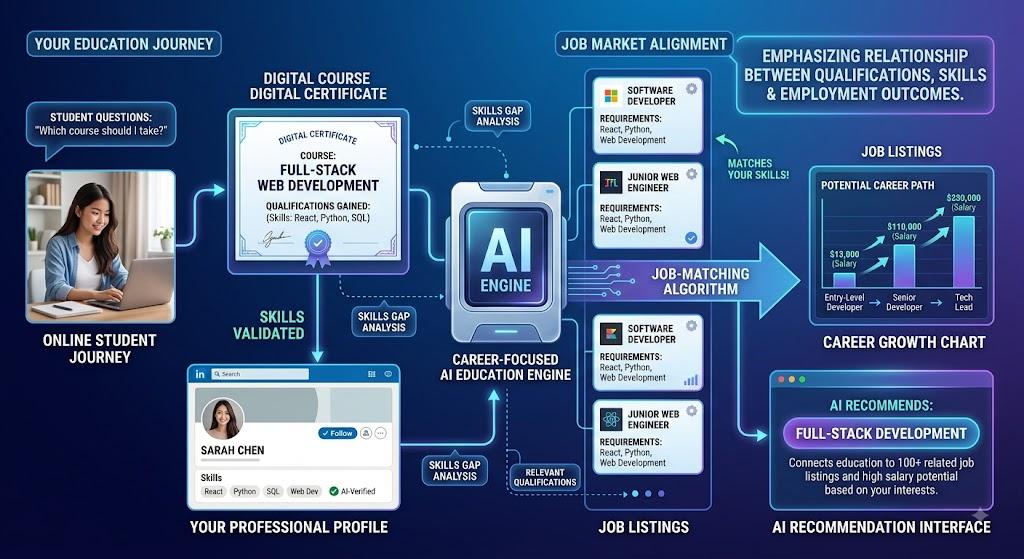
So, AI isn’t answering “which online course is best” as an academic question. It’s answering it as an employability question, drawing on job listings, professional profiles, and forum discussion about whether a qualification actually leads anywhere.
One more detail. FutureLearn’s and Coursera’s own domains sit at ranks 1 and 5. The platforms AI recommends are, in part, the platforms AI is reading. Your own site isn’t outside this system. It’s one of the largest inputs to it.
What to do with this information
There are four practical takeaways marketers can learn and apply in their day to day:
1. Pitch the outlets that review things
The citation set is technology and consumer review media. That means comparison pieces, roundups, and “best platforms for X” content, in the outlets that publish them. Education trade press matters for your sector reputation. On this evidence, it isn’t what AI reads when it answers a prospective student.
2. Widen the media list past the mastheads
Six of the 10 most-cited sources are independent publishers. If your target list only holds titles your board would recognise, it’s missing most of the citation set. These are working publications with engaged, specific readerships, which is plausibly why the engines are reaching for them. They’re also usually quicker to reach and quicker to say yes.
3. Check your own position before you spend anything
Everything above is the category. Where you sit inside it is a separate question, and the answer changes what you do first. Are you named in any roundup that AI currently cites? Which sources dominate your specific subject area rather than online education as a whole? Do you appear in these answers at all?
Tools like Temso’s AI search analytics, which is where this data comes from, track which prompts return your name, which of your pages get cited when they do, and who’s being named instead of you.
4. Treat this as a standing programme, not a campaign
Half the source list turns over most months. That cuts both ways. You don’t need to displace an incumbent, because positions open on their own. But a single win decays, so budget for continuous placement rather than one push.
The one thing you shouldn’t do is optimise your own site and stop. FutureLearn’s domain being the single most-cited channel shows owned content is a real input. It just isn’t a substitute for the third-party layer, which is where the other nine slots live.
Methodology
Figures are drawn from Temso’s AI Search Desk Report for Online Education in the United Kingdom. The index captures over 500,000 AI responses per month across ChatGPT, Google AI Overviews, Microsoft Copilot Search, and Grok Search, queried through each engine’s real consumer interface in the target country, and scores every brand, publisher, and channel by its share of unique responses in the segment. Source rankings cover the top 10.
About the author
Gerardo is the CEO and Co-Founder of Temso AI, and a leading voice on Answer Engine Optimization. He helps B2B marketing teams turn AI search into a measurable acquisition channel and writes about the playbook’s brands can use to get cited by ChatGPT, Perplexity, and Google AI Overviews. Before Temso, he founded and led product teams at multiple software companies valued at over $500 million.
Author Profile

- Chief of Marketing
- As the Chief of Marketing at the digital marketing agency ClickDo Ltd I blog regularly about technology, education, lifestyle, business and many more topics.
Latest entries
 ed techAugust 25, 2026How UK Students Can Save Money on the Tech They Need in 2026
 Digital MarketingAugust 11, 2026The Websites AI Relies on to Recommend Online Courses in the UK (2026 Data)
 Directory PostsAugust 5, 2026Top 5 UK Education Podcasts
 Directory PostsMay 9, 20269 Hot Student Discount Platforms to Save Big