

The first morning of a Spanish course in Mexico usually starts with a student standing on a street corner in Oaxaca or Guadalajara, holding a phone and trying to work out which of two identical blue doors is the language school.
The host family has sent directions by voice note, the timetable is in an email, and the class starts in ten minutes. For UK students taking an immersion course, a gap-year placement or a term abroad, it’s easy to see mobile data as a convenience to sort out later.
In practice it supports almost everything a language learner does in the first weeks, from finding the classroom to keeping up with coursework at home.
Language Learning Doesn’t Stop at the Classroom Door

Immersion works because the learning carries on outside lessons. That’s the whole point. You order lunch at a market stall, ask for directions, chat to your host family over dinner and try to follow the conversation on the bus. Each of these moments is a chance to practise, and each one is easier with a phone that can look things up on the spot.
Dictionary and language translation apps help you check a word before you use it, and the camera translation features in most of them will read a menu or a sign aloud. Many students also keep a running vocabulary list in a notes app or a flashcard app that syncs between devices. Host families and teachers often communicate by WhatsApp voice notes, which are excellent listening practice but need data to download when you’re out. Relying on Wi-Fi alone means saving all of that for the evening, and the useful moment has usually passed.
The First Week Is Where Connectivity Counts
The first week of any course abroad is full of small administrative tasks. You need to find the school, meet your host family or check into your accommodation, work out the local buses, find a cash machine that accepts your card and register for anything the school requires. Ride apps make late arrivals and unfamiliar neighbourhoods much less stressful, and maps stop you walking the long way round in the midday heat.
There’s a safety side to this too. Parents at home feel better when a student can share their live location on the first few evenings, and host families like to know when you’re on your way back. Save the school’s address and your host family’s number in your phone before you leave the UK, and note that the emergency number in Mexico is 911, so you aren’t searching for it when you need it.
This is where a Holafly eSIM for Mexico earns its place in a student’s plans: you install it in the UK before the flight, and the data is ready when you land rather than after you’ve found a shop that sells SIM cards. An eSIM is a digital SIM card that your phone downloads and stores on a chip that’s already built in, so there’s nothing to swap. Your UK number stays on the phone for calls and texts, which matters because UK banks, student finance and university systems often send security codes by text.
Before you buy, check that your phone supports eSIM, which most recent models do, and that it’s unlocked. A phone that came on a UK contract may still be locked to that network, and unlocking can take a few days. Install the eSIM at home over Wi-Fi, leave it switched off until you arrive, and then turn it on, select it for mobile data and enable data roaming for that line.
Coursework Back Home Doesn’t Pause
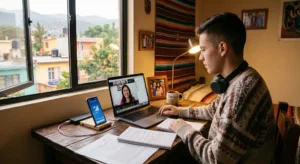
Many students in Mexico are still part of a UK course. Undergraduates on a year abroad submit assignments and attend tutorials online, sixth-formers on a gap year keep in touch about university applications, and adult learners might be fitting a course around remote work. All of that depends on a reliable connection.
Homestay and school Wi-Fi is usually fine for email but less dependable for a video call at an awkward hour, given the time difference with the UK. A phone with data can act as a backup, and its personal hotspot can get a laptop online when the house connection drops in the middle of a tutorial. It’s worth knowing how much data your usual habits use. Video calls and uploading large files take far more than messaging and browsing, so plan the size of your data package around the parts of your course that happen online.
A Safety Net for Longer Stays

Language courses have a habit of growing. A four-week course becomes eight because the progress is good, a weekend trip to the coast turns into a week, or a bus strike leaves you a day late getting back to class. For stays of a month or more, a monthly plan can be simpler than buying data for a fixed number of days.
Holafly’s eSIMs also include Always On, which is useful for exactly these situations. It’s a built-in backup plan that every customer gets: 1GB of data a month, available automatically when it’s needed and ready to activate when your main data runs out or something doesn’t go to plan. That gives you some leeway to check a bus timetable, message your host family and let your school know you’re on your way.
Back on that street corner on the first morning, the student with data on their phone opens the map, finds the right blue door and walks into class with a few minutes to spare. It’s a small thing, but on a course where every conversation counts, starting the first lesson calm rather than flustered is a good way to begin.
Author Profile

- Passionate education content creator and designer, contributor, writer and content marketing allrounder.
Latest entries
 language learningNovember 14, 2026Why Mobile Data Matters More Than You Think on a Language Course in Mexico
 Directory PostsNovember 13, 20266 Top Canadian Universities in Smaller Cities for International Students Planning to Stay in Canada
 Directory PostsOctober 20, 2026Top CMS & LMS Platforms for Educational Websites Compared – Magento, WordPress and Moodle
 distance learningSeptember 24, 2026Education ROI: Is an International Business Degree Worth the Investment?